make preferable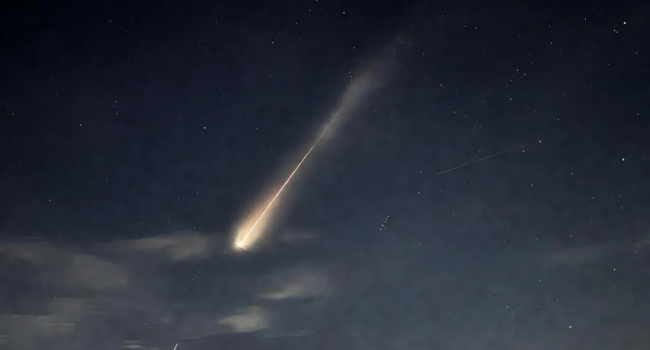
On the night of March 12, 2026, residents along the eastern coast of the Black Sea witnessed a bright astronomical event. According to the Laboratory of Solar Astronomy of the Space Research Institute of the Russian Academy of Sciences (IKI RAS), a small object—presumably a meteorite measuring from several tens of centimeters to about half a meter—disintegrated above the Black Sea.
What happened and where the fireball was seen
The bright fireball (bolide) was recorded between approximately 22:24 and 22:36 Moscow time. Reports and videos appeared in regional Telegram channels from Novorossiysk, Anapa, and Rostov-on-Don. The trail may also have been captured by south-facing cameras in Krasnodar and other cities within a 100–200 km radius along the coastline.
Published recordings show the object flashing brightly, fragmenting, and most likely completely disintegrating in the atmosphere. The exact coordinates have not yet been determined, but it most likely occurred directly above the Black Sea.
Scientists from IKI RAS emphasize that, based on the nature of the fragmentation, a technogenic origin cannot be ruled out—for example, debris from space junk or a satellite. However, a natural meteorite is also quite likely; objects of this size (up to 0.5 m) enter Earth’s atmosphere several times per day.
Connection with a recent event in Europe
This event is not related to the meteorite that flew over Western Europe on the night of March 10 (according to some sources, March 8). That fireball was observed over Germany, France, Switzerland, Belgium, Luxembourg, and the Netherlands. Its fragments fell in the German state of Rhineland-Palatinate, piercing the roof of a residential house with a hole roughly the size of a football. The flight was accompanied by bright flashes and a sonic boom. IKI RAS confirmed that it was a natural meteorite, moving from southwest to northeast.
What happens next
So far there have been no reports of debris falling on land or any damage. If the object indeed broke apart above the sea, any fragments (if they existed) likely sank.
Scientists continue analyzing videos and observational data to refine the object’s trajectory and determine its exact nature.
Such bright bolides are not rare, but they always attract attention because they provide an opportunity to better understand how small celestial bodies enter and break apart in Earth’s atmosphere.
In brief
On the night of March 12, 2026, a small object (up to 0.5 m) disintegrated over the Black Sea. A bright fireball was observed from Novorossiysk, Anapa, Rostov-on-Don, and nearby regions. The IKI RAS laboratory suggests it was likely a meteorite but does not rule out space debris. Any fragments most likely fell into the sea, and the event is not connected to the European meteorite seen on March 8–10. The phenomenon was captured in numerous videos, and no damage on land has been reported.