make preferable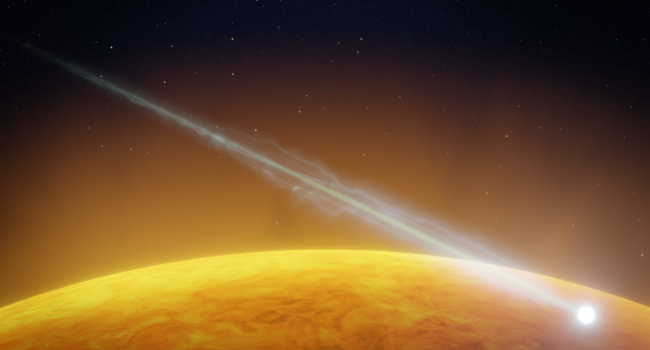
The recently discovered comet C/2026 A1 (MAPS), first observed in January 2026, appears destined for a dramatic end. According to scientists from the Space Research Institute of the Russian Academy of Sciences, the comet is on a trajectory that will take it directly into the Sun.
Researchers estimate that on April 4, 2026, the comet will plunge into the Sun and likely completely evaporate within the solar corona.
A member of the Kreutz sungrazer family
Comet C/2026 A1 (MAPS) belongs to the famous Kreutz sungrazers — a group of comets that pass extremely close to the Sun.
These objects often meet a destructive fate due to:
- intense solar radiation
- extreme tidal forces
- temperatures of millions of degrees in the solar corona
Astronomers estimate the comet will pass only a few hundred thousand kilometers above the Sun’s surface, a distance smaller than the Sun’s own diameter. At such proximity, the nucleus is expected to disintegrate and vaporize rapidly.
Discovery and increasing brightness
The comet was discovered on January 13, 2026, as part of the MAPS observation program, which involves amateur astronomers operating telescopes in the Atacama Desert.
Since its discovery:
- the comet’s brightness has increased about 30 times
- astronomers expect another doubling of brightness in the coming days
This rapid brightening is typical for sungrazing comets approaching the Sun.
A last chance to see it from Earth
Scientists say the comet’s final days may be spectacular.
Around 3–4 days before perihelion, the comet may experience a dramatic surge in brightness as its tail grows and reflects more sunlight.
During this period, C/2026 A1 (MAPS) could become visible to the naked eye, possibly even during daylight under favorable conditions.
The best viewing window will likely be:
- shortly after sunset
- about 5 hours after the Sun sets
- low above the western horizon
The most noticeable brightening may begin in the final days of March.
The final moments will be recorded
The comet’s destruction is expected to be captured by solar-observing spacecraft and coronagraphs, including:
- SOHO
- STEREO
These observatories continuously monitor the space around the Sun and regularly detect sungrazing comets during their final approach.
A fragment of an ancient comet
Astronomers believe C/2026 A1 (MAPS) may be a fragment of the Great Comet of 1106, a spectacular comet recorded in historical observations from China, Japan, and England nearly a thousand years ago.
That ancient comet fragmented into many pieces. Some of its remnants later returned as major sungrazers, including the famous Great Comet of 1843.
Now, this newly discovered fragment may be reaching the end of its long journey in the intense heat of the Sun.
In brief
The comet C/2026 A1 (MAPS), discovered in January 2026, is expected to fall into the Sun on April 4, 2026, where it will likely vaporize in the solar corona. The comet belongs to the Kreutz sungrazers, a family of comets that pass extremely close to the Sun. Its brightness has already increased about 30 times, and astronomers expect a dramatic brightening in late March, possibly making it visible to the naked eye before its final destruction. Observatories such as SOHO and STEREO are expected to record the event.