make preferable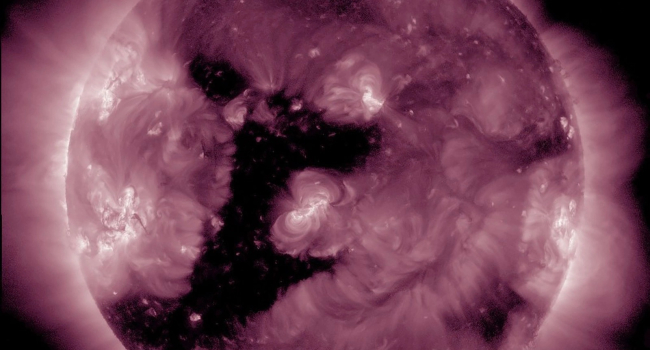
Scientists from the Space Research Institute of the Russian Academy of Sciences reported the formation of a new coronal hole on the Sun. At the moment, the structure is still developing, and no significant impact on Earth is expected over the next few days.
What is happening now
According to the Solar Astronomy Laboratory of IKI RAS, the outlines of the new coronal hole have already formed, but its influence on Earth is expected to begin only from Saturday, March 14. Until then, the geomagnetic environment should remain almost completely calm.
On March 10, geomagnetic conditions remain stable, while solar flare activity is slightly elevated. Around midnight, scientists recorded a C7.8-class solar flare, the strongest since February 25. However, the flare occurred near the left edge of the Sun, meaning it is not expected to produce geomagnetic effects on Earth.
Current Kp index values are around 2–3, which indicates only mildly elevated geomagnetic activity.
The estimated probabilities for March 10 are:
- geomagnetic disturbances — about 20%
- weak geomagnetic storms — about 7%
For the following two days, the probabilities are even lower: roughly 10% for disturbances and 3% for weak storms.
What a coronal hole is and why it matters
A coronal hole is a region in the Sun’s outer atmosphere where magnetic field lines open outward into space. These openings allow high-speed streams of solar wind to escape into the solar system.
When such streams reach Earth, they can trigger geomagnetic disturbances ranging from minor fluctuations to storms classified as G1–G3.
The newly formed coronal hole is still developing and currently positioned so that its solar wind stream is not directed straight toward Earth, which explains the expected calm conditions over the next few days.
What may happen next
If the coronal hole grows and moves closer to the center of the solar disk, the solar wind directed toward Earth could intensify. In that case, weak geomagnetic disturbances and possibly auroras at high latitudes may occur.
For now, however, scientists do not expect any serious effects.
By comparison, strong solar events in January and February 2026 produced G2–G3 geomagnetic storms, with auroras visible even at mid-latitudes. The current situation is far calmer.
In brief
A new coronal hole on the Sun has formed, but it is unlikely to significantly affect Earth until March 14. Solar flare activity is slightly elevated, with the strongest recent flare reaching C7.8, while the Kp index remains around 2–3. The probability of geomagnetic storms over the next few days is minimal. Overall, geomagnetic conditions are expected to remain calm until the weekend, according to the Solar Astronomy Laboratory of IKI RAS.