make preferable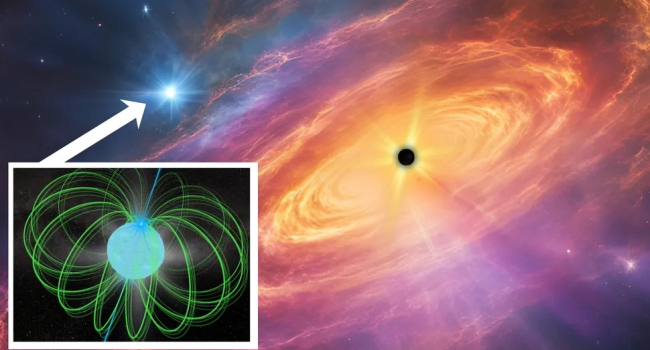
Astronomers searching for extraterrestrial signals as part of the Breakthrough Listen project may have stumbled upon an extremely rare object — a rapidly rotating neutron pulsar with an exceptionally strong magnetic field, located just a few thousand light-years from the supermassive black hole Sagittarius A* at the very center of our galaxy. If confirmed, this would be the first reliable candidate for a pulsar near Sgr A* and would provide a unique opportunity to test Einstein’s general theory of relativity under the most extreme conditions.
How the Candidate Was Found
The search was conducted between 2021 and 2023 using the Green Bank Telescope in West Virginia. Scientists were scanning the center of the Milky Way for technosignatures — artificial radio signals that could indicate intelligent life. Instead, they detected an unusual source: a pulsed signal with a period of 8 milliseconds (rotating 122 times per second). It was designated the Breakthrough Listen Pulsar (BLPSR).
“Our survey is one of the most sensitive ever conducted toward the Galactic Center. We should have detected roughly 10 percent of millisecond pulsars and 50 percent of normal slow pulsars if their population in the center resembles that in the rest of the Milky Way. Despite this sensitivity, we found only one candidate — BLPSR, which is now under active study,” said team leader Karen Perez from the SETI Institute.
Why This Is So Important
The Galactic Center is one of the most extreme environments in the universe: a supermassive black hole with a mass of 4 million Suns, an enormous density of stars, powerful magnetic fields, and a turbulent environment. In theory, many pulsars should exist there — neutron stars formed in supernova explosions of massive stars, spinning at extraordinary speeds and emitting narrow radio beams like cosmic lighthouses.
Yet BLPSR is the only candidate detected. This challenges current expectations about the number of pulsars near Sgr A*. If there are truly so few, it could mean that stars in the Galactic Center either rarely collapse into neutron stars, or that their emissions are heavily absorbed or distorted by the surrounding environment.
Cosmic Clocks for Testing Einstein
Pulsars are ideal natural clocks. Their pulses arrive with astonishing precision, and any external influence — such as the gravity of a massive object or the curvature of spacetime — produces measurable irregularities in their timing.
“Any external influence on a pulsar, such as the gravitational pull of a massive object, will cause anomalies in the regular arrival of pulses that can be measured and modeled. In addition, when pulses pass near a very massive object, they can be deflected and experience time delays due to spacetime curvature, as predicted by Einstein’s general theory of relativity,” explained team member Slavko Bogdanov of the Columbia Astrophysics Laboratory.
With a mass of 4 million Suns, Sgr A* creates extreme spacetime curvature. A nearby pulsar would be an ideal probe for testing Einstein’s theory in conditions impossible to reproduce in laboratories.
“If confirmed, this will help us better understand both our own galaxy and general relativity as a whole,” Karen Perez noted.
What Comes Next
For now, BLPSR remains only a candidate — further observations are required for confirmation. In the future, next-generation radio telescopes such as the next-generation Very Large Array (ngVLA) and the Square Kilometer Array (SKA) will assist. Their sensitivity and resolution should be sufficient to determine how many pulsars are truly hidden in the center of the Milky Way.
In Brief
The Breakthrough Listen team, using the Green Bank Telescope, has identified a pulsar candidate (BLPSR) in the Galactic Center, just a few thousand light-years from the black hole Sgr A*. It may be the first likely pulsar found so close to a supermassive black hole. Detecting only a single signal despite the survey’s high sensitivity raises an important question: why are there so few pulsars there? If confirmed, BLPSR would become a unique tool for testing general relativity in extreme gravitational conditions. Further observations with ngVLA and SKA are expected to provide answers.