make preferable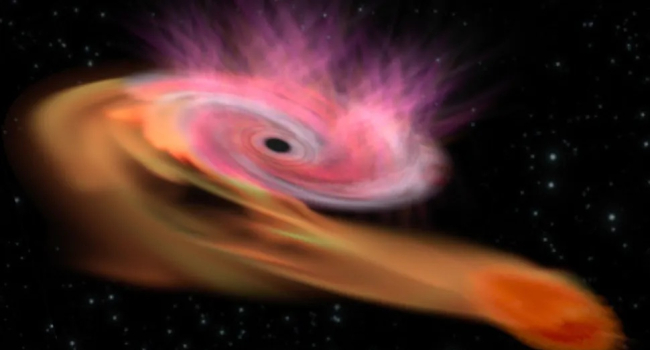
Astronomers have observed an extremely rare event — a star being torn apart by an intermediate-mass black hole, likely belonging to the long-sought class of “in-between” black holes. The event, designated AT2022zod, has become the first convincing candidate for such a black hole located outside a galactic center. The observations were published in The Astronomical Journal.
What Happened with AT2022zod
In October 2022, an unusually short and bright optical flare erupted in the galaxy SDSS J105602.80+561214.7, located about 1.5 billion light-years away. The flare lasted just over a month — from October 13 to November 18 — and then quickly faded. Typically, such flares, known as tidal disruption events (TDEs), last for hundreds of days or even years.
The key detail: the flare did not occur at the center of the galaxy, where a supermassive black hole usually resides, but roughly 10,000 light-years away from it. This strongly suggested that the culprit was not a central monster with millions of solar masses, but a much lighter object.
“AT2022zod has all the characteristics of a TDE — the flare we observe when a star is torn apart by a black hole,” explained team leader Kristen Dage of Curtin University. “Such events are rare in general, but since nearly every galaxy is expected to host a supermassive black hole at its center, TDEs usually occur there. However, AT2022zod is offset from the nucleus and is very short compared to other TDEs, while remaining highly energetic.”
Why It’s an “Intermediate” Black Hole
Black holes are typically divided into three classes:
- Stellar-mass (3–100 solar masses), formed by the collapse of massive stars;
- Supermassive (millions to billions of solar masses), located in galactic centers;
- Intermediate-mass (hundreds to tens of thousands of solar masses) — the theoretical “missing link” between the two.
For a long time, intermediate-mass black holes remained largely hypothetical because they are extremely difficult to detect. As Dage noted:
“I think it’s impossible to overstate how bad we are at finding intermediate-mass black holes. We’re excellent at finding supermassive ones, and thanks to LIGO-Virgo-KAGRA we’re getting better at detecting stellar-mass black holes. But the number of intermediate-mass candidates with any real community consensus can be counted on one hand.”
The duration of a TDE is proportional to the mass of the black hole: the lighter the object, the faster it “consumes” the star. AT2022zod lasted only a month — exceptionally short for an event 1.5 billion light-years away. Its brief duration and offset from the galactic center made it the leading candidate for an intermediate-mass black hole.
Where It May Have Been Located
The flare most likely occurred inside a very dense stellar environment — either a globular cluster or an ultra-compact dwarf galaxy (UCD). In such regions, stars are packed so closely together that the chances of one passing near a black hole are much higher than in a typical galactic field.
“If you’re not in some kind of stellar cluster — usually a central nuclear cluster — then a TDE simply won’t happen, because the odds of a star getting close enough to a black hole are too small,” Dage explained.
Globular clusters and UCDs are often described as “black hole factories,” where mergers and collisions can create intermediate-mass objects.
UCDs themselves may form in two ways: either as merged globular clusters or as stripped dwarf galaxies whose outer stars were torn away, leaving behind a dense core. In the latter case, they may represent “failed” supermassive black holes that never grew to full galactic scale.
What Comes Next
The discovery of AT2022zod provides a new strategy for finding intermediate-mass black holes: search for short, off-nuclear TDEs in dense stellar clusters.
When the Vera C. Rubin Observatory begins full operations in 2025, its Legacy Survey of Space and Time will scan millions of stellar clusters within a radius of 330 million light-years over a decade. If intermediate-mass black holes exist in significant numbers, they should reveal themselves through similar short-lived TDEs.
“Rubin is poised to make an enormous impact,” Dage concluded. “It will provide incredibly sensitive 10-year optical coverage of millions of stellar clusters within 330 million light-years and should be sensitive to TDE populations in dense stellar environments.”
In Brief
Astronomers have identified the rare event AT2022zod — a brief (just one month) stellar disruption flare that occurred 10,000 light-years away from a galaxy’s center. Its short duration and off-center location point to an intermediate-mass black hole (hundreds to thousands of solar masses), the long-sought “missing link” between stellar-mass and supermassive black holes. The flare likely took place in a dense stellar cluster — either a globular cluster or an ultra-compact dwarf galaxy. The discovery offers a promising new method for detecting intermediate-mass black holes: by searching for short, off-nuclear tidal disruption events.