make preferable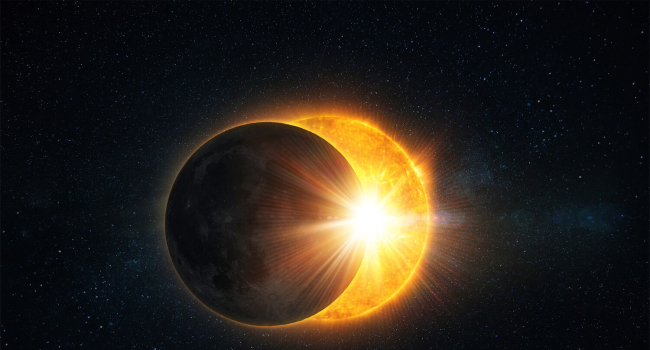
Eclipses do not happen randomly — they arrive in pairs, on schedule, and 2026 offers two clear examples. We usually hear about solar and lunar eclipses only a few days before they occur, often thinking of them as rare events happening somewhere far away. For months, the sky follows its ordinary rhythm — new moon, full moon — and then suddenly, within two weeks, two major eclipses take place.
In reality, everything follows a strict pattern: every eclipse occurs within a short but regular period known as an eclipse season.
What Is an Eclipse Season?
An eclipse season is a period lasting about 31 to 37 days during which both a solar and a lunar eclipse (or sometimes even three eclipses) can occur. These seasons repeat approximately every 173 days — roughly twice a year. Outside these windows, eclipses are simply impossible.
The reason lies in geometry. A solar eclipse can occur only at new moon (when the Moon is between Earth and the Sun), and a lunar eclipse only at full moon (when Earth is between the Moon and the Sun). For an eclipse to happen, the Moon, Earth, and Sun must line up in a straight line — a configuration astronomers call a syzygy.
But ordinary syzygies occur every month, while eclipses happen only a few times per year.
The key is the tilt of the Moon’s orbit. It is inclined by about 5° relative to the plane of Earth’s orbit around the Sun (the ecliptic). As a result, during most new and full moons, the Moon passes slightly above or below the critical alignment, and the shadow simply misses its target.
The Moon’s Nodes — The “Gateways” to Eclipses
The points where the Moon’s orbit intersects the ecliptic are called the lunar nodes (the ascending node and the descending node). When the Sun approaches one of these nodes, an eclipse season begins. During that month, the new and full moons occur close enough to the line of nodes for shadows to fall on Earth or the Moon.
An eclipse season opens when the Sun enters a “corridor” about 17–18° from a node and closes when it moves beyond that range. The nodes themselves slowly drift backward (a motion known as regression) at about 19.3° per year. As a result, eclipse seasons shift roughly 19 days earlier each year.
Why Eclipses Almost Always Come in Pairs
Once an eclipse season begins, a pair of eclipses becomes almost inevitable. A new moon near a node produces a solar eclipse. Two weeks later, a full moon near the opposite node produces a lunar eclipse — or the sequence may occur in reverse order.
Sometimes the geometry allows for a third eclipse at the edge of the season, but most often there are exactly two.
The 2026 Eclipse Seasons
First season — February–March 2026:
- February 17 — Annular solar eclipse (the Moon covers 96% of the Sun, leaving a “ring of fire” visible for up to 2 minutes 20 seconds). Visible only in Antarctica, with partial phases in southeastern Africa and South America.
- March 3 — Total lunar eclipse (the Moon remains fully immersed in Earth’s shadow for 58 minutes 18 seconds). Best visibility in East Asia, Australia, the Pacific region, and western North America.
Second season — August 2026:
- August 12 — Total solar eclipse (the path of totality crosses Greenland, Iceland, and northern Spain). Totality lasts several minutes, revealing the Sun’s corona. A partial eclipse will be visible across much of Europe, North Africa, and the North Atlantic.
- August 28 — Partial lunar eclipse (Earth will cover a significant portion of the Moon). Visible in North and South America, Europe, and Africa.
In Brief
Eclipses occur in pairs (or more rarely, in triplets) because they can only happen during short eclipse seasons — about every 173 days, lasting 31–37 days. A season begins when the Sun approaches a lunar node and ends when it moves away. During this window, a new moon produces a solar eclipse, and two weeks later a full moon produces a lunar eclipse (or vice versa).