make preferable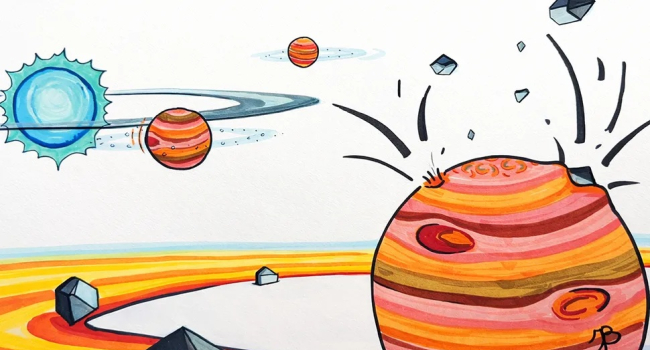
Astronomers using the James Webb Space Telescope (JWST) have gathered new evidence on how the most massive gas planets beyond our Solar System form. Observations of the HR 8799 system—a young star similar to the Sun, located 133 light-years away—show that even supermassive worlds can grow through the classical planet-formation process rather than forming like “failed stars.” This raises the upper limit of what we consider a true planet and blurs the boundary between planets and brown dwarfs.
The HR 8799 System: Four Giants on the Edge
HR 8799 is one of the best-known exoplanet systems. Around this young star (about 30–40 million years old) orbit four enormous gas giants, each with a mass between 5 and 10 times that of Jupiter. They orbit far from their star, in regions where the protoplanetary disk disperses quickly and material for growth is scarce.
For years, scientists debated whether such massive planets form through core accretion—a bottom-up process like Jupiter and Saturn, where a solid core forms first from dust and ice and then captures gas—or via gravitational instability, a top-down collapse of a gas cloud similar to stars or brown dwarfs.
Sulfur in the Atmosphere: A Key Marker
A team from UC San Diego, Caltech, UCLA, and other institutions used JWST’s infrared spectrometers to study the atmospheres of the three inner planets (HR 8799 c, d, and e). Instead of focusing solely on common molecules like water, carbon monoxide, and methane, the researchers searched for sulfur compounds, specifically hydrogen sulfide (H₂S).
The results, published on February 9, 2026, in Nature Astronomy, were surprising: H₂S was clearly detected in HR 8799 c’s atmosphere, and likely present on the other planets as well. Sulfur in protoplanetary disks exists as solid grains rather than gas, so its abundance in a planet’s atmosphere indicates that the planet first accumulated a large amount of solid material for its core before capturing gas.
Jean-Baptiste Ruffio of UC San Diego, the study’s lead author, noted that the discovery suggests HR 8799’s planets likely formed like Jupiter, despite being 5–10 times more massive—a finding that was unexpected. The planets also showed enrichment in heavy elements (carbon, oxygen, sulfur) relative to the star, another hallmark of classical core accretion.
Implications for Planet Classification
Previously, it was thought that core accretion was inefficient at such large distances and masses because the disk disperses faster than a core can grow. JWST’s observations now show that this mechanism can operate even for “super-Jupiters.” This pushes up the upper mass limit for planets formed through classical processes and challenges the boundary between giant planets and brown dwarfs, which fuse deuterium rather than hydrogen like stars.
If similar results are confirmed in other systems, astronomers may need to reconsider the line between planets and substellar objects.
In Brief
JWST has, for the first time, detected hydrogen sulfide (H₂S) in HR 8799 c’s atmosphere. This demonstrates that the system’s supermassive gas giants (5–10 Jupiter masses) formed via core accretion, like Jupiter, rather than through gas collapse like brown dwarfs. The planets are enriched in heavy elements, including sulfur, raising the upper mass limit for “normal” planets and blurring the distinction with “failed stars.” The study was published in Nature Astronomy on February 9, 2026.