make preferable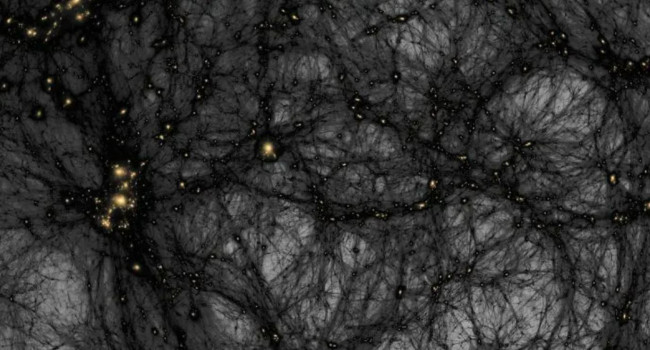
Dark matter is one of the most persistent “ghosts” in modern physics. It is believed to make up about 85% of all matter in the Universe, yet it does not interact with light and has never been directly detected in any experiment. Now, Indian physicist Naman Kumar of the Indian Institute of Technology proposes a radical alternative: perhaps dark matter does not exist at all, and its effects can instead be explained by gravity behaving differently on extremely large scales than scientists currently assume.
Why Dark Matter Was Proposed in the First Place
The idea originated from observations of galaxy rotation. Stars on the outskirts of galaxies move far too quickly — if gravity were produced only by visible matter (stars, gas, dust), those outer regions should have flown apart long ago. Gravitational lensing tells a similar story: light from distant objects bends more strongly than visible mass alone can account for. Astronomers therefore concluded that vast, invisible halos of dark matter must surround galaxies.
Yet decades of searching for dark matter particles — including WIMPs, axions, and other candidates — have produced no confirmed detections, neither in underground detectors nor at the Large Hadron Collider.
A New Idea: Gravity “Runs” at Large Scales
Kumar approached the problem from the perspective of quantum field theory, applying what is known as an infrared running scheme to the gravitational constant G, Newton’s famous “big G.”
Gravity is usually assumed to be constant across all scales. However, in quantum field theory, interaction constants can “run,” meaning they change depending on energy or distance. Kumar examined gravity’s behavior at scales comparable to infrared wavelengths and beyond — essentially galactic and intergalactic distances.
He writes in an article for Phys.org that the result is a compelling theoretical scenario in which the effective strength of gravity slightly changes at galactic distances.
In this framework, the gravitational potential no longer strictly follows the inverse-square law (1/r²). Instead, at extremely large distances, a component emerges that scales as 1/r — a much longer-range force.
This modification can explain the flat rotation curves of galaxies — where stellar velocities do not decline with distance from the center — without invoking additional invisible mass.
Is It Compatible with Observations of the Early Universe?
A critical requirement is that any modification of gravity must remain consistent with data from the cosmic microwave background (CMB) and the formation of large-scale cosmic structures. Kumar argues that, in his model, gravitational corrections grow slowly with scale and time. During the early Universe — when the CMB formed and the first structures emerged — the effects would have been minimal and consistent with observations. On later cosmic timescales and larger distances, however, the effect becomes noticeable — precisely where dark matter is currently inferred.
What Comes Next — and Why It Matters
Kumar emphasizes that his work opens a pathway to understanding dark matter phenomena not as missing particles, but as a subtle feature of gravity itself — a deep consequence of scale dependence in the quantum field theory of gravity.
He also notes that although the approach does not yet fully substitute for dark matter in the standard cosmological model — particularly in explaining detailed structure formation and lensing data — it highlights the possible hidden complexity of gravity and invites a reassessment of the origin of dark matter effects.
The study was published in Physics Letters B.
In Brief
Physicist Naman Kumar suggests that dark matter may not exist. Its observed effects — rapid galaxy rotation and strong gravitational lensing — could be explained if gravity slightly changes its behavior at galactic scales, transitioning from a 1/r² law to a longer-range 1/r component due to the “running” of the gravitational constant in quantum field theory. The model is consistent with early-Universe data and does not require new particles. While it is not yet a full replacement for cold dark matter (CDM), it offers an alternative perspective on one of cosmology’s greatest mysteries.