make preferable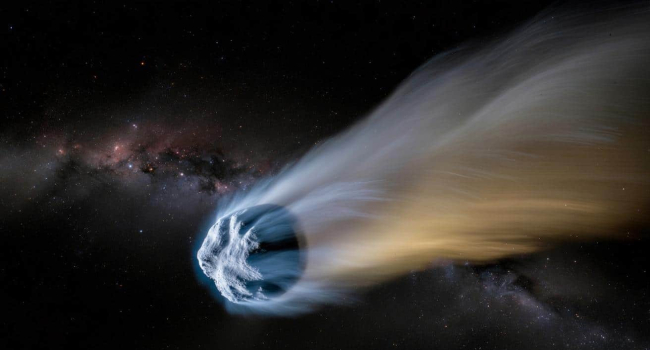
The interstellar comet 3I/ATLAS, discovered in the summer of 2025, sparked a wave of excitement across media and social networks. Some enthusiasts even speculated that it might not be a natural object at all, but an alien spacecraft. Gennady Krasnikov, President of the Russian Academy of Sciences, provided a clear scientific explanation for the comet’s unusual behavior in an interview with RIA Novosti, effectively dispelling the speculation.
What Was Unusual About the Comet’s Behavior
Comet 3I/ATLAS (officially C/2025 N1 (ATLAS)) did behave differently from typical “local” comets of the Solar System. It changed its rotation speed and color — phenomena that appeared anomalous at first glance. Krasnikov offered a simple explanation: the object originated from another star system and had never approached our Sun before.
“Comet 3I/ATLAS was not from our Solar System and therefore had not been exposed to the strong influence of our Sun… As a result, it behaved somewhat unusually — its rotation speed changed, and so did its color,” he noted.
Ordinary comets tend to have stable orbits because they pass perihelion multiple times; their surfaces are effectively “weathered” by solar wind, and their ice and gases have long been activated. Interstellar visitors are different — their surfaces can remain pristine for billions of years. When such an object encounters intense stellar radiation and solar wind for the first time, it can react unpredictably: uneven outgassing may alter its spin and even its coloration due to fresh material being released.
According to Krasnikov, astronomers had calculated these changes in advance. The comet’s orbit has been precisely determined, and the level of danger is zero — it passed at a safe distance from both Earth and the Sun.
Age and Discovery
The comet was discovered on July 1, 2025, by the ATLAS survey system in Chile. It is the third confirmed interstellar object after 1I/ʻOumuamua (2017) and 2I/Borisov (2019). Observations by NASA, ESA, the Hubble Space Telescope, and other instruments suggest the comet is more than 7.5 billion years old — about 3 billion years older than the Sun and our planetary system.
3I/ATLAS passed perihelion in late October 2025 at a distance of roughly 1.4 AU and is now heading back into interstellar space.
An Alien Ship? No — Just a Sensation
Krasnikov dismissed theories about an “alien probe” as fabrications created for media buzz. He emphasized that while the excitement surrounding such a mysterious object is understandable, science provides clear answers: this is a typical — albeit very ancient — comet from another star system. All observed anomalies fit within the known physics of interstellar objects.
Such visitors are rare, but they help scientists better understand how stars and planets form across the galaxy. Observations of 3I/ATLAS have already yielded valuable data about the composition of primordial material.
In Brief
President of the Russian Academy of Sciences Gennady Krasnikov explained the anomalies of comet 3I/ATLAS — including changes in rotation and color — by its interstellar origin, noting that the object had not been exposed to solar wind for billions of years. It is the third known interstellar visitor, discovered on July 1, 2025, and estimated to be over 7.5 billion years old. It poses no danger, and all parameters have been carefully calculated. Claims that it could be an alien spacecraft are merely sensationalism, while its behavior is fully consistent with scientific understanding.