make preferable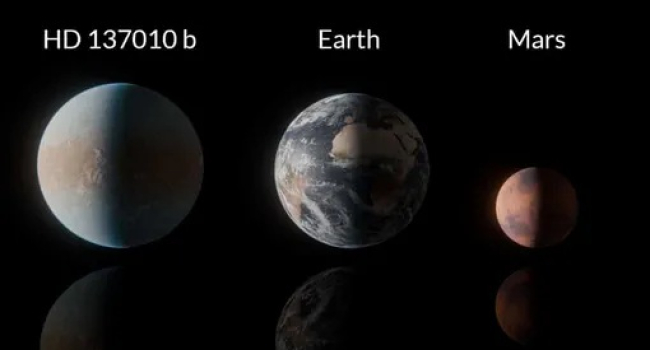
An international team of astronomers from Australia, the United States, the United Kingdom, and Denmark has announced the discovery of the exoplanet HD 137010 b, one of the closest and most physically Earth-like worlds beyond the Solar System. The study was published in The Astrophysical Journal.
A planet resembling both Earth and Mars
HD 137010 b was identified through a reanalysis of archival data from the K2 mission of the Kepler space telescope, collected during its extended mission phase in 2017. The planet’s radius is only about 6 percent larger than Earth’s, and its orbital period is 355 Earth days, remarkably similar to our own year.
Its host star is Sun-like, though slightly cooler and dimmer. As a result, the planet receives roughly the same amount of stellar energy as Mars. Calculations suggest its equilibrium temperature could drop below minus 70 degrees Celsius. The probability that the planet lies within the habitable zone is estimated at around 50 percent, which is relatively high for an exoplanet of this type.
One of the key advantages of this discovery is the brightness of the host star. It is close and luminous enough to allow detailed atmospheric observations in the coming years using the James Webb Space Telescope and next-generation ground-based observatories.
Why this discovery matters
HD 137010 b is the first candidate with such Earth-like parameters in terms of size and orbital period that transits a Sun-like star. This makes it an exceptional target for spectroscopy and atmospheric studies. If its status is confirmed, it will rank among the most promising objects for the search for biosignatures and potential signs of extraterrestrial life.
Until now, most Earth-like exoplanets have been found either around red dwarf stars, where conditions differ significantly from those around the Sun, or at distances too great for detailed observations. HD 137010 b combines relative proximity, a suitable host star, and a transiting orbit, an ideal combination for future research.
In short
Astronomers have discovered the exoplanet HD 137010 b located 146 light-years from Earth. Its radius is only 6 percent larger than Earth’s, its orbital period is 355 days, and the probability of it lying within the habitable zone is estimated at 50 percent. The planet transits a Sun-like star, making it possible to study its atmosphere in detail. Its surface temperature is likely similar to that of Mars, potentially below minus 70 degrees Celsius. This makes HD 137010 b one of the closest and most Earth-like candidates for the search for life using the James Webb Space Telescope and future observatories.