make preferable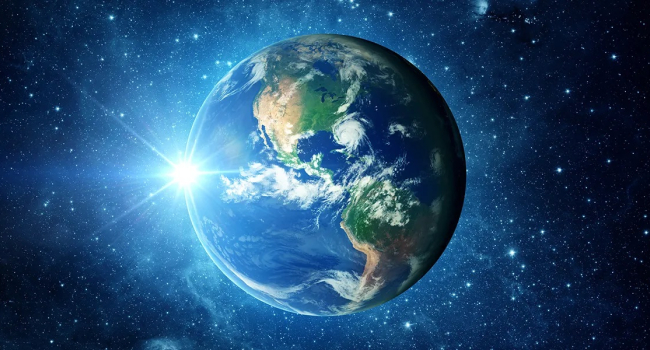
Right now, you’re racing through space at tremendous speed, along with every other living creature on Earth. Our planet is constantly moving in two main ways: it rotates on its axis, like a spinning top, and revolves around the Sun. Earth completes one full rotation in 24 hours, reaching speeds of about 1,670 km/h (1,040 mph) at the equator. At the same time, it travels around the Sun at an average speed of 107,000 km/h (66,000 mph), completing a full orbit every year. These speeds are far beyond anything humans can experience on Earth — yet we don’t feel dizzy or fly off into space. The explanation lies in physics, as Space.com explains.
Why Don’t We Notice the Motion?
When you feel movement — on a ride, for instance — it’s usually due to sudden acceleration, braking, or turning. Earth, however, moves with incredible smoothness. Over billions of years, its rotation and orbital motion have stabilized, with no abrupt jerks or halts. While Earth’s speed slightly changes depending on its distance from the Sun (it speeds up when closer and slows down when farther), these variations happen so gradually that our bodies can’t detect them.
Imagine being on an airplane cruising at high altitude: despite traveling hundreds of kilometers per hour, everything inside feels calm. You, your seat, and the air around you all move together at the same speed. The same happens on Earth — you, the trees, the buildings, and the oceans are all moving along with the planet, so there’s no relative motion for your body to sense. To actually feel it, Earth would have to suddenly accelerate, slow down, or change direction, which, fortunately, it doesn’t.
Earth Is Enormous
Another reason we don’t notice Earth’s motion is its immense size. The planet’s diameter at the equator is about 13,000 kilometers (8,000 miles) — roughly the distance from New York to Los Angeles and back. We are like tiny ants on a massive beach ball, far too small to perceive its movement. The sheer scale of Earth makes its rotation and orbit effectively invisible to our senses.
Moreover, space offers no nearby visual references that could reveal our motion. On a road, you can tell you’re moving by watching trees and lampposts go by, but in space, the stars are so far away they appear motionless — even though we’re hurtling through space at tens of thousands of kilometers per hour. Gravity, acting like an invisible embrace, keeps everything anchored to the planet’s surface, preventing us from being flung into space.
How Did We Discover That Earth Moves?
Even though we can’t feel Earth’s movement, people realized long ago that the planet both rotates and revolves around the Sun by observing the sky.
- Day and night are caused by Earth’s rotation: without it, one side of the planet would always face the Sun while the other remained in darkness.
- The seasons result from the tilt of Earth’s axis, which changes how much sunlight different regions receive throughout the year.
- Stars and constellations slowly shift across the night sky because of Earth’s rotation, and their positions change with the seasons as we move along our orbit.
Modern observations from satellites and space telescopes confirm these ancient deductions, providing direct visual evidence of Earth’s motion. Even though we can’t see nearby “landmarks” rushing past, the clues are all around us — in the cycle of day and night, seasonal changes, and the apparent drift of the stars.
The Universe Is Always in Motion
Earth isn’t the only object on the move. The Sun itself rotates and travels around the center of the Milky Way Galaxy at hundreds of thousands of kilometers per hour. In fact, everything in the universe — planets, stars, galaxies — is in constant motion. We just don’t notice it because we’re all moving together, like passengers aboard a colossal cosmic ship.
In Short…
Earth spins at 1,670 km/h at the equator and races around the Sun at 107,000 km/h, yet we don’t feel it because its motion is smooth and consistent, and the planet’s size is immense. Gravity keeps us firmly on the surface, and with no nearby visual references in space, the motion is imperceptible. The cycle of day and night, changing seasons, and shifting stars prove that Earth is constantly in motion — just like everything else in the universe.