make preferable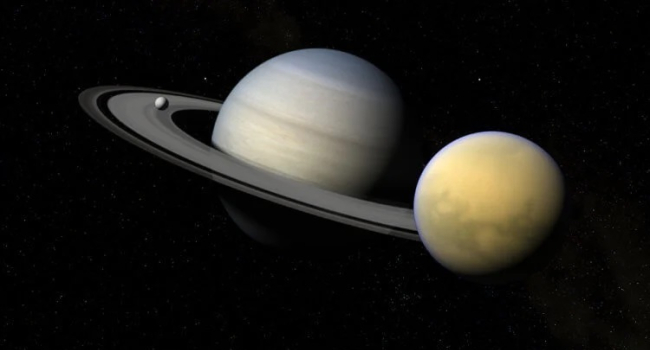
Titan, Saturn’s largest moon, with its thick atmosphere and subsurface ocean, has long tantalized scientists as a potential cradle for alien life. An international team of astrophysicists and biologists from the U.S., Canada, the U.K., and beyond set out to test this idea. Their findings, published in The Planetary Science Journal (TPSJ), surprised them: life on Titan is possible, but its scale is humbler than the weight of a small dog.
The Subsurface Ocean: Hopes vs. Reality
Beneath Titan’s icy crust—hundreds of kilometers thick—lies a global ocean of liquid water laced with methane and ammonia. NASA estimates its volume at 10–12 times that of all Earth’s oceans combined. With water, organic molecules, and a stable temperature (around -90°C at the surface but warmer below), it seems a prime candidate for life. Yet the new model reveals that any biosphere here would be sparse.
The researchers calculated that the total biomass of hypothetical microbes in Titan’s ocean would amount to just a few kilograms—roughly 5–10 kg, akin to a chihuahua or pug. That translates to less than one bacterial cell per liter of water. By contrast, Earth’s oceans teem with millions of microbes per milliliter.
Why So Little?
The bottleneck is organic matter availability. Titan’s surface brims with hydrocarbons like methane and ethane, plus complex molecules like the amino acid glycine—potential “food” for microbes. But getting this bounty to the ocean depths is a slog. The team modeled two delivery methods: seepage through ice cracks and meteorite impacts. Both proved too slow and inefficient.
“Titan looks organic-rich, but that’s deceptive. Most of it stays trapped on the surface or in shallow ice. Only a tiny fraction reaches the ocean—too little to sustain a thriving ecosystem,” explained lead author Antonin Affholder from the University of Alberta.
How Might Life Survive?
If microbes exist on Titan, they’d likely rely on fermentation—breaking down organic molecules without oxygen to release energy. On Earth, this was common 3.5 billion years ago before oxygen filled the atmosphere. Titan’s oxygen-free ocean fits this primitive metabolism. Even so, such frugal life would form sparse, isolated colonies—oases in a desert.
Implications for the Search for Life
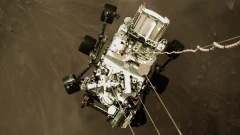
This dims Titan’s glow as a “second Earth,” but it doesn’t rule out life entirely. A few kilograms of bacteria may be modest, but it’s enough to leave traces. NASA’s Dragonfly mission, set to launch in 2028 and land on Titan in 2034, could test the theory. The rover will hunt for biosignatures—methane, amino acids, or lipids—in surface dunes and perhaps near craters where ice thins. Drilling through hundreds of kilometers to the ocean, though, remains beyond current tech.
There’s a twist: some scientists, like those from Cornell University (not involved here), propose life on Titan might not need water at all, using liquid methane as a solvent instead of H₂O. That’s a speculative leap requiring a different search strategy.
Titan vs. Other Moons
Compared to fellow “water worlds” like Saturn’s Enceladus or Jupiter’s Europa, Titan lags. Enceladus spews organic-rich geysers, and Europa likely boasts active hydrothermal vents—both could support biomass orders of magnitude greater. Titan’s vast ocean, isolated beneath thick ice, emerges as a relative pauper.
The Bottom Line
Life on Titan isn’t a long shot, but it’s not thriving either. A few kilograms of bacteria in its subsurface ocean suggest scattered pockets clinging to meager resources, not a bustling ecosystem. The study highlights a hard truth: water and organics don’t guarantee abundance. Titan remains an enigma—only missions like Dragonfly will reveal if these “cosmic chihuahuas” exist or if the moon stands as a silent relic of the solar system’s past.