make preferable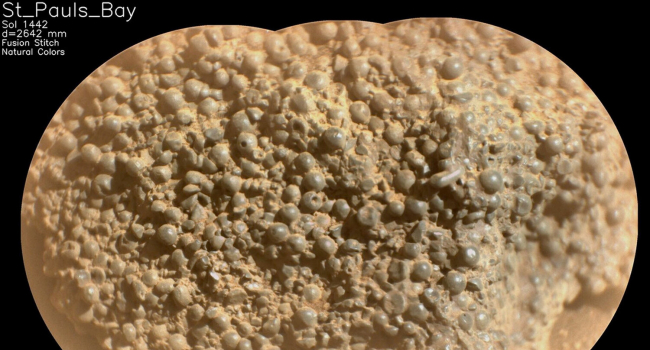
Mars continues to captivate scientists, unveiling its secrets through NASA’s rovers. Recent discoveries—record-breaking long organic molecules and a peculiar stone studded with hundreds of spherical formations—have sparked intrigue. These findings not only deepen our grasp of Martian chemistry and geology but also inch us closer to answering the ultimate question: Was there ever life on Mars?
The Longest Organic Chains on Mars
A team of researchers from the U.S., Mexico, and Spain has made a groundbreaking discovery: organic molecules with carbon chains up to 12 atoms long in Martian soil. Detected in Gale Crater by the Sample Analysis at Mars (SAM) instrument on the Curiosity rover, these structures resemble Earth’s fatty acids—compounds often tied to biological processes. The findings were published in the Proceedings of the National Academy of Sciences (PNAS).
The samples date back an astonishing 3.7 billion years, aligning with the era when life emerged on Earth. Mars’ unique conditions—minimal geological activity, aridity, and frigid temperatures—acted like a time capsule, preserving these ancient “chemical fingerprints.” While there’s no direct evidence of a biological origin, the discovery confirms that Mars once hosted complex organic chemistry, potentially a foundation for life.
This breakthrough is fueling excitement for future missions. The European ExoMars project (set for launch in 2028) and a NASA-ESA collaboration to return Martian soil in the 2030s now have sharper targets for hunting traces of ancient organisms.
A Mysterious Stone with Hundreds of Spheres
Meanwhile, the Perseverance rover stumbled upon an equally fascinating find near Broom Point, at the base of Witch Hazel Hill. Among layers of light and dark rock—long a point of interest from orbit—researchers spotted a stone dubbed St. Pauls Bay. Its surface is dotted with hundreds of millimeter-sized spheres, ranging from dark gray orbs to elongated shards with tiny holes.
NASA scientists are scratching their heads over how these structures formed. It’s not Mars’ first curveball of this kind. In 2004, the Opportunity rover uncovered “Martian blueberries” in Meridiani Planum. Later, Curiosity spotted similar formations in Gale Crater, and Perseverance previously found popcorn-like textures in the Neretva Vallis riverbed.
Possible Explanations
The leading theory points to concretions—mineral deposits formed in rock pores by ancient groundwater. But alternatives abound: the spheres might be frozen lava droplets from a volcanic eruption or remnants of vaporized rock ejected during a meteor impact. Unraveling their origin demands more geological context.
A wrinkle in the puzzle? St. Pauls Bay is a “float” rock, meaning it didn’t form where it was found—it ended up there by chance. Scientists are trying to link it to the dark layers of Witch Hazel Hill visible from orbit. Early analyses suggest it might belong to those strata, but definitive answers await further study.
What It Means for Science
Both discoveries—the long carbon chains and the spherical formations—highlight Mars’ rich past. The organic molecules hint at chemical processes that could have paved the way for life, while the enigmatic spheres narrate geological tales from billions of years ago. These finds will guide future research, helping us peel back the layers of Mars’ history one step at a time.