make preferable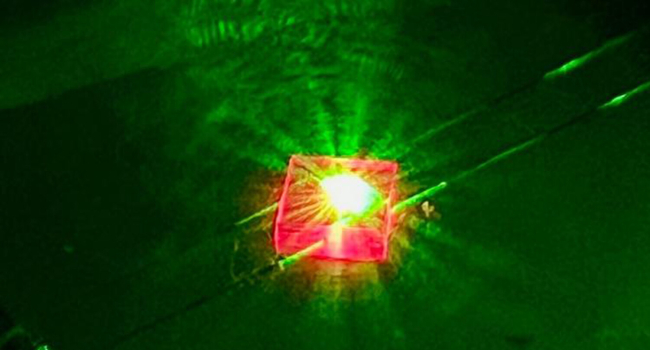
A team of scientists from the University of Washington in the U.S. has developed a groundbreaking time quasicrystal—a novel phase of matter where particles oscillate in distinct yet precisely ordered rhythms. Their findings, detailed in Physical Review X (PRX), push the boundaries of physics and challenge conventional notions of time.
What Are Time Crystals?
Traditional crystals, like diamonds or quartz, feature atoms arranged in a repeating spatial pattern. Time crystals take this a step further: their structure is organized not just in space but also in time, with particles oscillating in a predictable, clock-like rhythm. This four-dimensional nature—three spatial dimensions plus time—sets them apart as a unique state of matter.
First experimentally confirmed in 2016 at the University of Maryland, time crystals have evolved. The Washington team’s latest creation, a time quasicrystal, marks a leap into uncharted territory.
How Do Time Quasicrystals Differ?
In standard time crystals, all particles vibrate at a uniform frequency. Time quasicrystals, however, feature particles pulsing to multiple, distinct rhythms that remain meticulously coordinated—like a musical chord rather than a single note. This newfound complexity opens doors to groundbreaking applications in quantum science.
“We’re confident we’ve created the first true time quasicrystal,” said lead researcher Guanghui He.
How Was It Made?
The team started with a millimeters-wide diamond, bombarding it with nitrogen beams to dislodge carbon atoms and carve out tiny voids. These cavities trapped electrons that interacted at a quantum level. Over a million microscopic voids—each about a thousandth of a millimeter—formed within the diamond, serving as the building blocks of the quasicrystal. Microwave pulses then triggered the system, syncing the electrons into an ordered temporal dance.
What’s Next?
Time crystals are hypersensitive to magnetic fields and quantum effects, making them prime candidates for cutting-edge tech. Building a time quasicrystal is a critical step toward harnessing it for quantum sensors and future computing systems, said co-author Chong Zu.
This breakthrough could revolutionize quantum electronics, offering more stable platforms for data storage and processing. By bending our grasp of time, these crystals might just redefine the future.