make preferable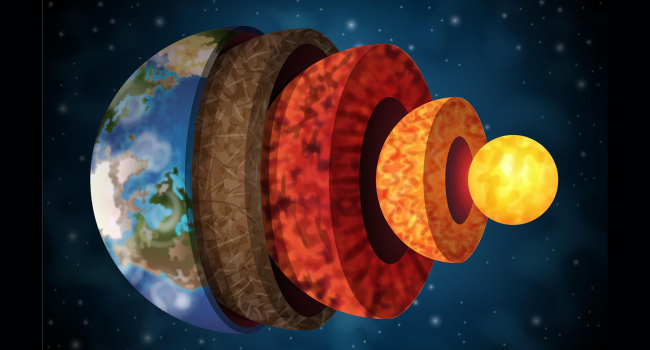
Researchers have declared that Earth's inner core is slowing down and might completely stop by 2040, according to a report in the journal Nature.
What's Happening with Earth's Core?
At the center of our planet lies a hot metallic core with a radius of about 1300 kilometers. Composed of iron and nickel, it is surrounded by a liquid outer core, which in turn is enclosed by the mantle.
Scientists note that the core plays a pivotal role in creating Earth's magnetic field. This process occurs due to geodynamo – a mechanism where the movement of liquid metal generates the magnetic field.
- From the early 1970s, the inner core has been rotating from west to east.
- However, between 2009 and 2010, its movement completely halted.
- Currently, scientists have observed that the core has started moving in the opposite direction relative to Earth's surface.
- According to calculations, if this trend persists, the core could stop again by 2040.
After a complete stop, it is likely to resume rotation in the same direction as the rest of the planet.
What Could Be the Consequences?
Scientists cannot yet precisely predict how this will affect life on Earth's surface. However, possible consequences include:
- Changes in the Magnetic Field - Weakening of Earth's magnetic shield could impact the planet's protection against cosmic radiation.
- Impact on Climate - Restructuring of flows within the core could affect the distribution of heat within Earth's interior.
- Changes in Seismic Activity - Alterations in core movement could potentially influence tectonic processes.
Researchers continue to study this phenomenon to understand its long-term effects.