make preferable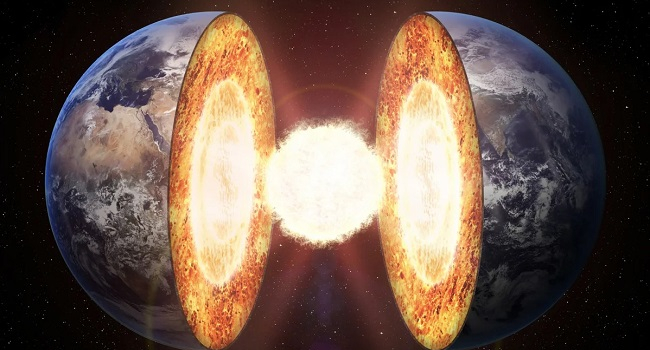
A study by American scientists has revealed that Earth's inner core is not fully solid and is subject to deformation. This process could influence the planet's rotation and the length of the day. The findings were published in Nature Geoscience.
Structure of Earth's Core
The inner core is located about 4,800 kilometers beneath the Earth's surface. For a long time, it was considered a solid sphere surrounded by a liquid outer core. However, seismic data from recent decades have shown that its surface may be much more plastic than previously assumed.
What Earthquake Data Revealed
To study the structure of the inner core, the scientists analyzed 121 recurring earthquakes recorded between 1991 and 2024.
Special attention was given to anomalous seismic waves detected by stations in Alaska and Canada. Previously, such changes had not been observed, but after refining their analysis methods, the researchers concluded:
- The inner core is not entirely solid, and its surface may change.
- This is due to the interaction between the liquid outer core and the inner core.
How This Affects Earth
According to the lead author of the study, Professor John Vidal, turbulent flows in the outer core could cause shifts and deformations in the inner core.
This discovery is crucial for understanding the processes occurring deep within our planet:
- It helps explain changes in Earth's rotational speed, which could affect the length of the day.
- It provides new data about the mechanisms that influence Earth's magnetic field.
- It allows for a better understanding of thermal processes within the planet.
What’s Next?
While the new model of the core alters our understanding of its structure, the scientists emphasize that further analysis is needed. In the future, more precise seismic measurements will help determine how much the inner core can deform and how this affects Earth.