make preferable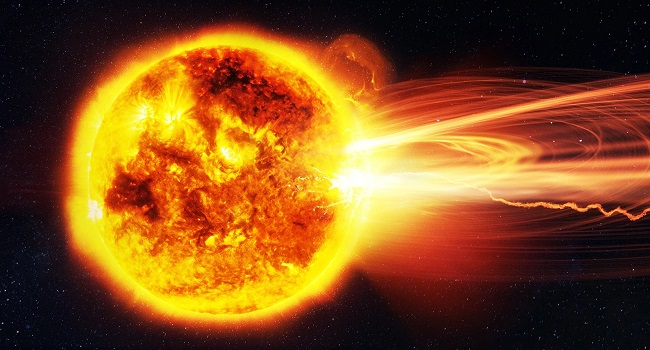
Solar activity has increased again — astronomers have recorded a series of flares of varying intensity. This was reported by TASS with reference to the Institute of Applied Geophysics (IPG).
What flares occurred?
On January 31 at 09:10 Moscow time, a flare of class M1.0 in the X-ray range was recorded in the sunspot group 3976 (N11E41). Its duration was 32 minutes.
On the same day, six more flares of class C occurred in the same group of spots. The first flare of level C4.1 was registered at 00:25 Moscow time.
On January 29 at 07:08 Moscow time, another flare of class M1.0 with a duration of 48 minutes was observed in the sunspot group 3977 (N23E70).
On January 31, two additional flares of class C were also recorded, according to the Solar Astronomy Laboratory of the Space Research Institute (IKI) of the Russian Academy of Sciences.
It’s interesting: The flare class is designated by Latin letters:
- C — average power
- M — penultimate level
- X — the most powerful flares capable of causing magnetic storms
Unusual ejection on the Sun
Another interesting phenomenon was recorded on January 24. Scientists from the Space Research Institute of the Russian Academy of Sciences reported the ejection of an unusual black structure.
This color is probably associated with a high content of neutral hydrogen. Astronomers suggest that it was a cold prominence ejected as a result of a powerful flare.
The black cloud of plasma remained visible for three hours, after which it dissipated.
How does this affect the Earth?
M-class solar flares can cause disturbances in the magnetosphere and small geomagnetic storms. However, C-class flares usually do not have a significant effect.
Scientists continue to monitor the activity of the Sun, as in 2024–2025 it is approaching the maximum of the 11-year cycle, which means an increase in the number of flares and coronal mass ejections.