make preferable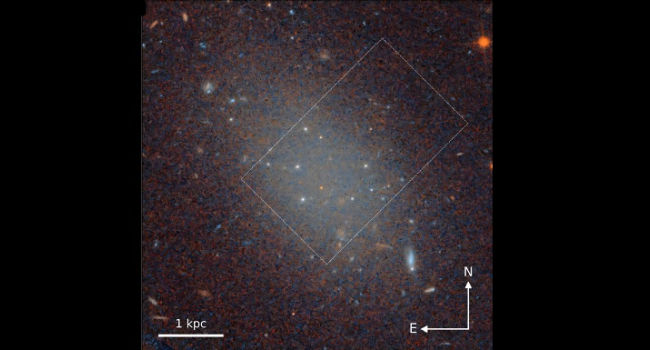
Astronomers led by Iman Tan from the University of California, Santa Cruz, studied the galaxy FCC 224, located in the Fornax galaxy cluster. Observations conducted using the Hubble Space Telescope revealed an unusual system of globular star clusters with unique characteristics. The results of the study were published in a preprint on arXiv.
What are globular clusters and why are they important?
Globular star clusters are dense groups of gravitationally bound stars orbiting galaxies. They play an important role in studying the evolution of stars and galaxies, since they form during periods of intense star formation.
The galaxy FCC 224 is distinguished by its relatively low mass - about 200 million solar masses - and compact size (diameter 6,160 light years). However, scientists found 12 extremely bright globular clusters in it, which was unexpected for such a low-mass galaxy.
Anomalous properties of clusters
To better understand the nature of these clusters, the researchers used:
- Hubble's Wide Field Camera 3 — to study the structure of the galaxy in detail.
- Keck Cosmic Web Imager — to analyze the chemical composition and properties of the clusters.
The data obtained showed:
- The total mass of the clusters is 3.8 million solar masses, which is equivalent to 2% of the mass of the entire galaxy — much more than expected.
- The colors of the stars in the clusters are almost identical to the colors of the rest of the stars in the galaxy.
- The spread of colors in the star clusters is extremely small, indicating that they all formed in one short and powerful episode of star formation.
- More massive clusters are concentrated closer to the center of the galaxy, while less massive ones are located on the periphery.
What does this mean for science?
Scientists cannot yet explain how such massive and bright star clusters formed in such a small galaxy.
One possible explanation is gravitational interactions with other galaxies, which could have led to accelerated star formation in the past. However, there are no exact answers yet.
The main question is: why do these clusters still exist and have not dispersed over billions of years?
The authors of the study emphasize that further theoretical research and new astronomical observations will be needed to explain these phenomena.