make preferable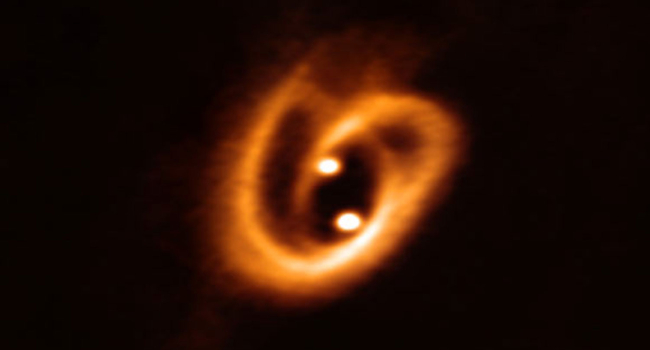
Japanese astronomers from Niigata University have made an amazing discovery: two huge icy spheres have been discovered within our galaxy, the origin of which cannot be explained by the known laws of physics. The study was published on the arXiv scientific preprint platform.
What are these objects?
The giant blue balls were discovered using the Japanese AKARI telescope and the Atacama Large Millimeter Array (ALMA) antennas in Chile. The sizes of the objects are astounding - they are approximately 10 times larger than the Solar System. Their distance from Earth is 30.3 thousand and 43.7 thousand light years, which places them on the outskirts of the Milky Way.
Features of observations
Scientists note that spectral analysis of the objects showed the presence of ice and dust - characteristics that are often found in young star-forming regions or against the background of dense clouds covering stars. However, these objects are located in regions where there are no star-forming regions or known dense clouds, which makes them even more mysterious.
“These icy balls show unique properties that are not characteristic of any known type of object,” the researchers write.
Hypotheses of origin
According to one of the suggestions, the discovered spheres may represent an entirely new class of isolated icy objects. Their formation may be associated with processes that do not yet fit into current models of galaxy evolution.
Further research
To clarify the nature of the objects, scientists plan to use more powerful telescopes, such as the James Webb Space Telescope and upcoming next-generation projects. These instruments will allow us to obtain detailed spectra and find out exactly how such giant structures were formed.
The discovery adds another mystery to the list of unsolved questions in modern astronomy and indicates that even our own Milky Way galaxy holds many secrets waiting to be revealed.