make preferable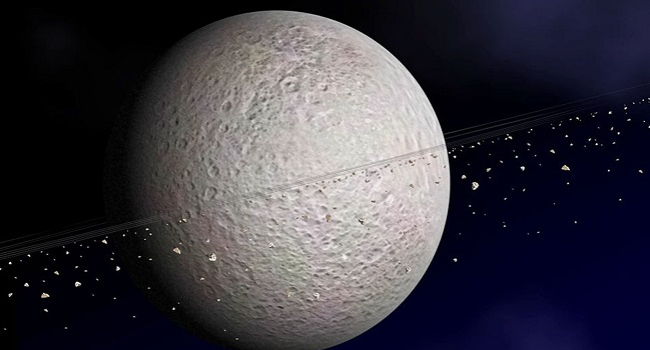
French astrophysicists from the University of Grenoble-Alpes have conducted computer simulations showing that the Earth's Moon may have had rings like Saturn in the past. This is stated in a study published in the journal Astronomy and Astrophysics (A&A).
Results of the simulations and unexpected conclusions
Experts studied five systems of planets and their satellites, including the Earth and the Moon, and added hypothetical rings to the satellites. Simulations showed that such structures could have been preserved for millions of years, despite the complex gravitational interaction with the planets.
The stability of the ring systems was estimated based on the movement of particles inside them. For the Moon, the probability of maintaining a stable ring system was 95%.
It was expected that the gravity of the planets would destroy the rings, but the simulations showed the opposite: the rings became more stable and even acquired wave-like patterns reminiscent of the structure of Saturn's rings. The exception was Saturn's moon Mimas, whose rings turned out to be unstable.
Why does the Moon have no rings now?
Scientists believe that the rings could have disappeared under the influence of non-gravitational factors:
- Solar radiation destroyed the ring particles;
- Magnetic fields and charged particles affected their structure.
If the Moon's rings had survived to our time, they would probably decorate the night sky like Saturn's rings, creating a breathtaking spectacle.