make preferable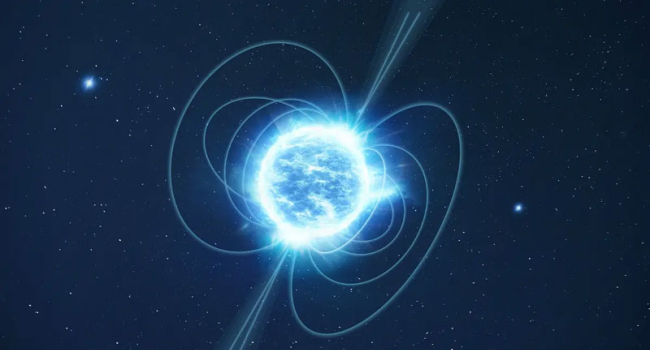
Scientists from Indiana University (USA) have suggested that there are tiny "mountains" on the surface of neutron stars that, despite their size, are capable of causing gravitational waves. These results were published in the journal Physical Review D (PRD).
Neutron stars are formed from the remains of massive stars that have experienced gravitational collapse. These super-dense objects have extreme physical properties. Although their surface remains a mystery, researchers believe that it is covered with a layer of solid matter, similar to a planetary crust, but much denser.
Mechanism of "mountain" formation
The irregularities that scientists have called "mountains" arise due to the peculiarities of the internal structure of neutron stars. For example, the anisotropic properties of the crust material, where physical characteristics vary depending on the direction, can contribute to the formation of stable deformations. Such "mountains" are incredibly small by terrestrial standards - their height is only a few millimeters, but the enormous density of neutron stars makes their gravitational influence significant.
Gravitational Waves and LIGO
These irregularities can produce persistent gravitational waves – ripples in space-time caused by the movement of massive objects. Modern observatories such as LIGO are already capable of detecting such oscillations.
According to the researchers, detecting gravitational waves from neutron stars with “mountains” will allow us to study their internal structure and test the fundamental laws of physics. These signals can reveal secrets of the Universe’s past, as they carry information about events that happened billions of years ago.
The Significance of the Study
Confirming the existence of such “mountains” will be an important step for astrophysics. It will help to better understand the properties of neutron stars and their interaction with the surrounding space-time. In addition, gravitational wave data can serve as a new tool for studying the earliest stages of the Universe’s development.