make preferable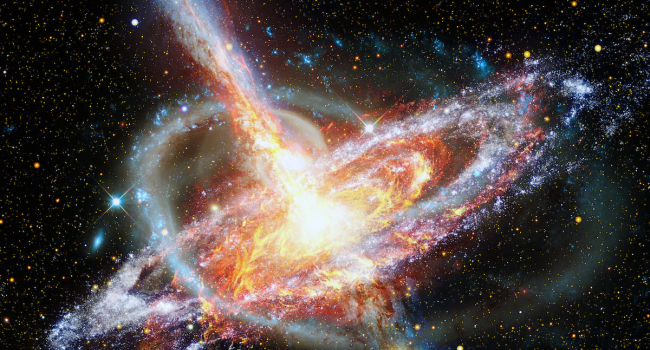
American astrophysicists from leading scientific institutions, including Princeton and MIT, have identified an unexplained factor that is holding back the expansion of cosmic structures. The study, published in Physical Review Letters (PRL), challenges existing models that describe the evolution of the Universe.
Study of the ΛCDM model
The team of scientists focused on the ΛCDM model, which explains the large-scale structure of the cosmos. This model describes the evolution and structure of the cosmos, encompassing cold dark matter (CDM) and the cosmological constant Λ ("lambda"), which takes into account dark energy.
ΛCDM has successfully predicted many phenomena, such as cosmic microwave background radiation and the acceleration of the expansion of the Universe. However, it faces a number of unresolved issues, including:
- Discrepancies between different methods for measuring the expansion rate of the Universe.
- The possibility of the existence of dynamic dark energy.
Key findings of the study
- Slowing growth rate of structures
Analysis of the data (including the BOSS spectroscopic study of baryon oscillations) showed that the growth rate of cosmic structures is lower than predicted by ΛCDM.
- Dark energy remains constant
Scientists did not find convincing evidence of dynamic dark energy. This confirms that dark energy behaves like an unchanging cosmological constant.
- Unexplained anomaly
The results point to a mysterious factor suppressing the growth of the Universe. The probability of this observation being a coincidence is estimated at 1 in 300,000.
What's next?
The study confirms the accuracy of existing data on the density of matter and the Hubble constant, but raises questions about the nature of the anomaly. For now, the causes of the phenomenon remain beyond the scope of current physical models.
Scientists are continuing their research, wanting to understand how these results can be related to new concepts in physics, and possibly point to the existence of unknown fundamental interactions.