make preferable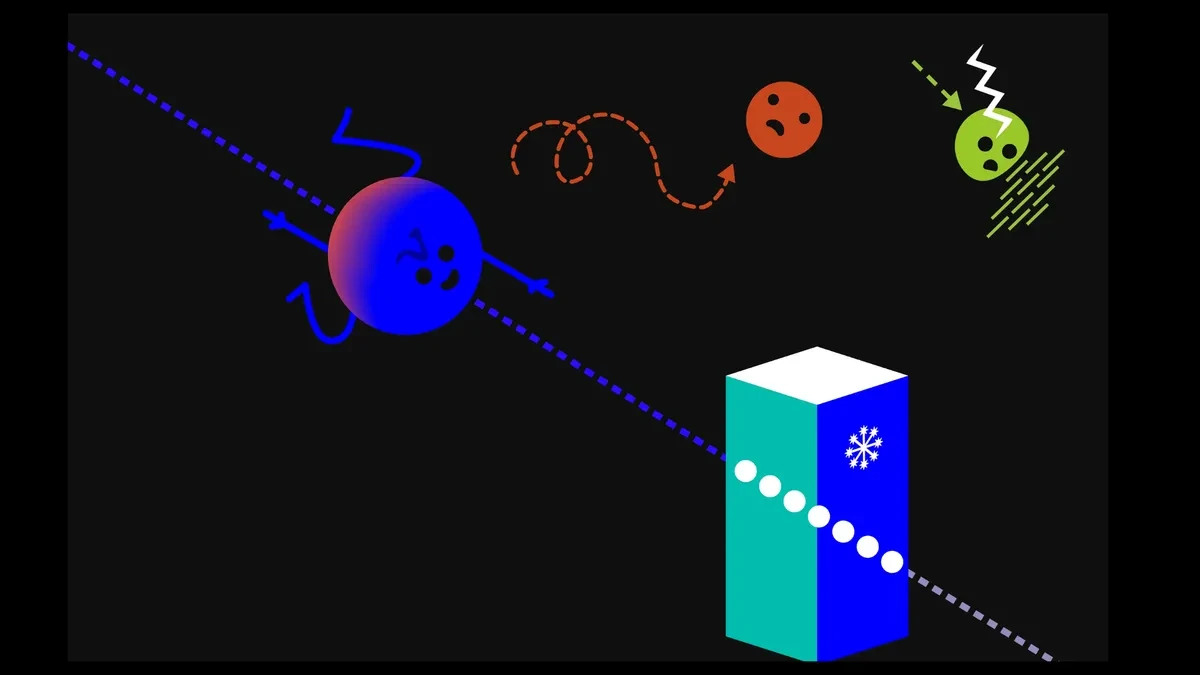
Francis Halzen was awarded the 2026 Nobel Prize in Physics for his key contribution to the creation of the IceCube observatory and the discovery of high-energy neutrinos of astrophysical origin. The detector, located deep beneath the ice at the South Pole, made it possible to observe particles that pass through the Universe almost unhindered and carry information about the most powerful cosmic processes.
Neutrinos are called “ghost particles” for good reason: hundreds of trillions of these particles pass through the human body every second, interacting with matter only very weakly. This very property both makes neutrinos a unique source of information about the Universe and turns their detection into an extraordinarily difficult task, Space.com reports.
Particles that pass through Earth
Neutrinos are among the most abundant particles in the Universe. Only photons — particles of light — outnumber them. However, unlike light, neutrinos interact very little with surrounding matter.
They have no electric charge, their mass is extremely small, and they move at nearly the speed of light. As a result, neutrinos can travel vast distances with almost no deflection and without losing energy.
This makes them a kind of cosmic messenger. Light from a powerful astrophysical object can be absorbed, scattered, or deflected on its way to Earth. Neutrinos preserve information about their source much better.
High-energy neutrinos are especially interesting. They are thought to be produced in extremely powerful cosmic processes that act like giant particle accelerators. If such a neutrino can be detected, scientists gain the opportunity to study processes that cannot be reproduced on Earth.
The problem is that most neutrinos pass through detectors just as easily as they pass through the human body.
A billion tons of ice instead of an ordinary telescope
In 1988, Halzen proposed using the ice of the South Pole to search for neutrinos. The idea was to turn a huge volume of transparent ice into a detector.
The South Pole turned out to be a suitable place for such an experiment. There are no ordinary sources of background radiation there, and the absence of significant seismic activity creates favorable conditions for measurements.
The result was the IceCube observatory — a giant detector with a volume of about 1 cubic kilometer. Thousands of light sensors were placed deep within the Antarctic ice.
Scientists do not see the neutrino itself. Sometimes it does collide with an atom in the ice and produces a secondary charged particle. That particle, in turn, triggers a brief flash of light. From these flashes, IceCube reconstructs the direction and energy of the original neutrino.
The result is a kind of telescope that looks not at light, but at particles passing through the planet.
The first cosmic neutrinos
IceCube began collecting data as early as 2005, and the observatory was fully completed by 2011.
In August 2011 and January 2012, researchers recorded particles informally named Bert and Ernie. They became the first evidence of neutrinos of astrophysical origin detected in this way.
In November 2013, scientists announced the detection of 26 more astrophysical neutrinos. This was important confirmation that IceCube is capable of detecting particles that came from beyond the Solar System.
This gave rise to a new branch of astronomy — neutrino astronomy. Unlike traditional telescopes, it makes it possible to study the Universe using particles that can reach Earth directly from the regions where the most powerful cosmic events take place.
Why this changes our understanding of the Universe
Before the advent of such detectors, scientists mainly observed cosmic objects using electromagnetic radiation — from radio waves to gamma rays. Neutrinos provide another channel of information.
Their special nature is especially important in the study of extreme objects and processes. A particle can leave a region where powerful particle acceleration is taking place, pass through space and Earth, and only in rare cases collide with an atom inside IceCube.
That is why the detection of each high-energy neutrino can be so valuable. It makes it possible to connect a recorded particle with distant cosmic sources and gradually understand where and how particles of extreme energies arise in the Universe.
“Francis Halzen led the international team of researchers and engineers who created a fantastic instrument,” said Mark Pearce, chair of the Nobel Committee for Physics. According to him, Halzen’s persistence and scientific vision paved the way for a new kind of astronomy.
IceCube continues to collect data. That means scientists have the opportunity to search for new high-energy neutrinos and the cosmic phenomena associated with them — including ones they do not even know about yet.