make preferable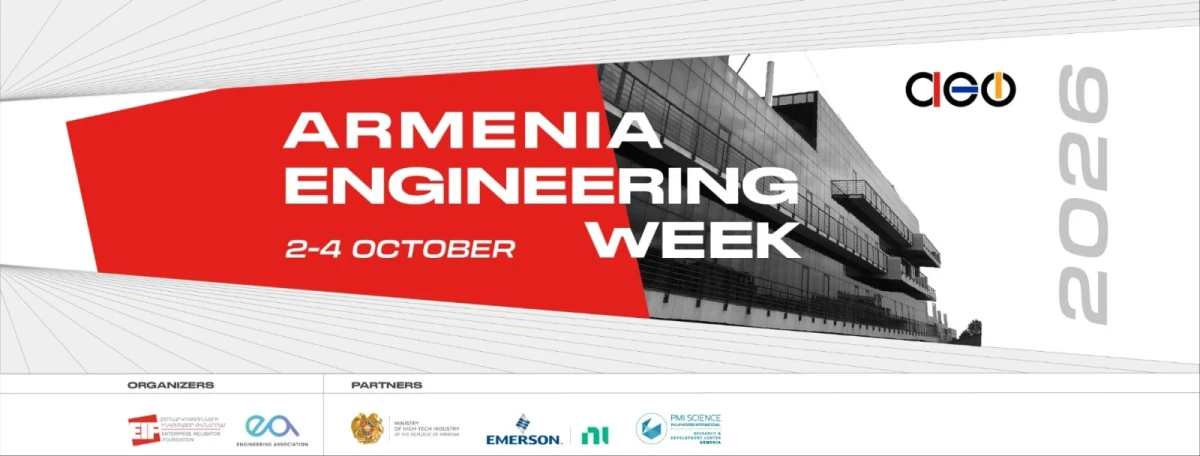
Armenia–Engineering Week 2026, the country’s largest engineering event series, opened in Yerevan on October 2. This year, it is dedicated to Physical AI — artificial intelligence embodied in physical systems. Unlike familiar AI systems that work primarily with text, images, and data, Physical AI must perceive the surrounding world, make decisions, and act within it — using robots, sensors, electronics, embedded computing systems, and control mechanisms.
In 2026, Engineering Week is being held for the tenth time. Over three days — from October 2 to 4 — the program spans Yerevan and Vanadzor and brings together representatives of the engineering industry, science, education, government, and international technology companies.
The main theme of this year’s forum is “Physical AI: Engineering Intelligence for the Real World”. The organizers propose viewing artificial intelligence not as an exclusively software-based technology, but as the foundation of a new generation of physical systems.
From chatbots to machines that act
In recent years, AI has developed rapidly primarily in the digital environment: models have learned to analyze massive amounts of data, generate text and images, write code, and interact with users.
But the next stage of development requires moving beyond the screen.
For artificial intelligence to control a car, a robot, an industrial machine, or a medical device, a neural network alone is not enough. It needs cameras and other sensors, electronics, control systems, computing power, mechanical components, manufacturing, and testing.
Physical AI emerges precisely at the intersection of these disciplines.
That is why the Engineering Week 2026 program covers not only artificial intelligence, but also robotics, semiconductors, automotive and aerospace engineering, high-performance computing, cybersecurity, manufacturing, and medical devices.
From autonomous systems to humanoid robots
The first day of the forum at Engineering City in Yerevan began with speeches by representatives of the government, international organizations, and the technology business. Key speakers include SEMI Europe President Laith Altimime, Microchip Technology Corporate Vice President Shakeel Peera, IEEE Fellow and robotics pioneer Gregory Chirikjian, Metacomp Tech CTO Oshin Perumyan, and Huawei Armenia CEO Alex Zhao.
Special attention is being paid to robotics. The program includes a presentation on how robots learn to represent the surrounding world and interact with it, as well as a live demonstration of a humanoid robot.
This is an important emphasis: Physical AI implies not merely the creation of smarter algorithms, but the emergence of machines capable of using those algorithms to interact with the physical world.
The forum also discusses autonomous systems, hardware solutions, the use of AI directly in engineering laboratories, and the application of artificial intelligence to research automation.
AI enters the engineering laboratory
One of the first day’s topics is the use of AI directly in engineering experiments.
In particular, participants are discussing laboratories where machine learning algorithms can take part in the design and testing of hardware solutions, as well as hardware-in-the-loop technologies — an approach in which software models and real system components work together within a single experimental cycle.
The idea is to shorten the path from hypothesis to a working engineering solution: some operations that previously required constant involvement from a specialist can be automated, while algorithms can analyze experimental results and suggest the next steps.
This is especially important in fields where the number of possible options is too large for manual trial and error.
Physical AI is not only about robots
Although humanoid machines are becoming the most visible symbol of Physical AI, the concept itself is much broader.
The Engineering Week program includes semiconductors, aerospace, automotive engineering, manufacturing, biotechnology, and medical devices.
For example, one dedicated session focuses on the development of medical devices and on how engineering ideas are turned into technologies that can be trusted in real-world medicine. The requirements here are especially high: a device must not only work, but also be safe, reproducible, and compliant with strict quality standards.
At the same time, participants are discussing the development of infrastructure for agentic AI — systems that not only respond to user requests, but also independently carry out a sequence of actions.
Thus, the discussion is about the transition from standalone AI tools to full engineering systems in which artificial intelligence becomes one of the components of a physical product.
Engineering as a condition for technological independence
For Armenia, this topic also has a broader meaning.
Engineering Week is positioned not only as a technology conference, but also as a platform for developing the national engineering ecosystem. Universities and research organizations, technology companies, government institutions, international corporations, and startups come together in one place.
This approach is especially important for Physical AI: it is impossible to develop such a system through the efforts of a single narrow specialty. Specialists are needed in machine learning and programming, electronics and microchips, mechanics, materials science, robotics, manufacturing, and quality control.
That is why one of Engineering Week’s main tasks is to connect these competencies and create conditions for joint projects.
On the first day, this is addressed in particular by the panel Science Meets Engineering — Physical AI, Real-World Challenges, where scientists and industry representatives discuss the real problems that arise when transferring AI from the digital environment into the physical world.
From engineering business to young professionals
The second day, October 3, will be devoted not only to discussions, but also to hands-on engagement with technology.
Engineering Expo will take place at Engineering City, where developments in electronics, semiconductors, automotive engineering, aerospace technologies, manufacturing, biotechnology, and engineering software will be presented.
Visitors will be able to see demonstrations of a humanoid robot, tour Engineering City’s technology and research facilities, and take part in interactive activities.
A separate part of the program is devoted to investment in engineering projects and the development of technology ecosystems. Among the second day’s topics are the use of AI in the industrial revolution and even the use of AI in the fashion industry.
And on October 4, the event will move to Vanadzor, where Youth Innovation Day will take place.
There, the focus will be on young engineers and students: an exhibition of engineering developments, practical workshops, and master classes will be organized for them. The program also includes a discussion of Physical AI and a demonstration of the G1 humanoid robot.
The next step is to teach machines to interact with the world
The main difference between the current stage of AI development and previous ones is that artificial intelligence is gradually ceasing to be an exclusively software product.
A model that can write text exists inside a computer. A model that controls a robot must take into account friction, lighting, the position of objects, the movement of a person nearby, motor limitations, and many other factors of the real world.
Therefore, the development of Physical AI effectively means bringing together two previously relatively independent worlds — artificial intelligence and engineering.
This very transition is becoming the central theme of Armenia–Engineering Week 2026. The organizers see it not only as the next stage in AI development, but also as an opportunity to strengthen Armenia’s engineering capabilities, connect local companies and researchers with the international technology ecosystem, and create new avenues for high-tech business.
The forum’s three days in Yerevan and Vanadzor are intended to show what the next stage of Armenia’s engineering industry could look like: when intelligence stops living only inside a computer and begins to act in the physical world.