make preferable
Dark matter remains one of the greatest mysteries in modern physics. It neither emits nor absorbs light, yet its gravitational influence is felt everywhere—from the rotation of galaxies to the large‑scale structure of the Universe. Among the hypothetical candidates for this invisible substance, "dark photons" have long been considered—particles that could serve as force carriers in the "dark" sector, analogous to ordinary photons in electromagnetism.
For a long time, many cosmological observations had all but ruled out the existence of dark photons. A new study, published on 13 August in the journal Physical Review Letters, now shows that previous constraints were too strict. If the calculations are correct, the parameter space for searching for these particles expands significantly.
Why dark photons were "forbidden"
According to earlier models, in the early hot Universe, dark photons would have gradually converted into ordinary photons. This process would have heated the already hot plasma and left noticeable traces in the cosmic microwave background and other cosmological data. To avoid contradicting observations, the interaction between dark photons and ordinary matter had to be made extremely weak—about a hundred million times weaker than the new calculations allow.
It was precisely these tight constraints that led many physicists to consider dark photons an unlikely candidate.
What the computer simulations changed
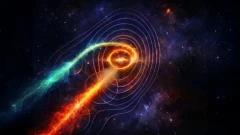
A team of researchers, including scientists from the University of Maryland and the Perimeter Institute for Theoretical Physics, discovered an important nuance. Previous calculations relied on a linear approximation: energy was assumed to transfer smoothly and gradually. However, more accurate computer models revealed that the process is in fact highly non‑linear.
As soon as a small fraction of the dark photon energy transfers to ordinary plasma, the plasma itself "goes wild"—complex non‑linear effects arise that quickly stop further conversion. As a result, significant heating of the early Universe simply does not occur.
Junwu Huang from the Perimeter Institute explained that the linear approximation used for the past fifteen years gives a huge energy transfer, but that this is impossible, adding that non‑linearities essentially switch off the process after only a tiny fraction of energy has been transferred.
New opportunities for the search
Thanks to this discovery, previously "closed" parameter regions become accessible to experiments once again. According to Anson Hook from the University of Maryland, the interaction strength of dark matter could be eight orders of magnitude greater than previously thought permissible.
He emphasised that this work opens up many new opportunities for searching for dark matter.
The researchers note that a correct calculation of plasma behaviour in the early Universe will allow future experiments to probe previously inaccessible regions and perhaps finally detect signals from dark photons.
In brief
New computer simulations have shown that dark photons—hypothetical dark matter particles—would not have heated the early Universe as strongly as previously thought. Non‑linear effects in the plasma quickly halt the conversion of dark photons into ordinary ones. This removes earlier tight constraints and significantly expands the parameter space in which scientists can search for these particles. The work was published in Physical Review Letters and could reshape the strategy for hunting dark matter.