make preferable
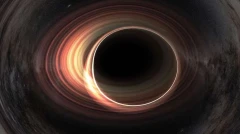
At the very heart of our galaxy, next to the supermassive black hole Sagittarius A*, astronomers have detected a star that has set a new speed record. The object, designated S301, accelerates to 25,000 kilometres per second—more than 8% of the speed of light. No other known star in the Milky Way has ever moved this fast, reports Space.com.
A record-breaker on a very tight orbit
S301 orbits the black hole—which has a mass of about 4.3 million Suns—in just 8.7 years. At its closest approach, the star comes within a mere 12 astronomical units of Sagittarius A*, or roughly 12 times the distance from Earth to the Sun. For an object circling a supermassive black hole, this is an extraordinarily compact orbit.
"The special thing about this star is that it moves on a very small orbit and gets incredibly close to the black hole. We have never seen anything like this before," said Felix Mang, a graduate student at the Max Planck Institute for Extraterrestrial Physics and one of the authors of the discovery.
How S301 was found
The star was first spotted in 2023 using the GRAVITY instrument on the Very Large Telescope (VLT) of the European Southern Observatory in Chile. Researchers then traced its motion through archival data from 2021 and 2017. S301’s orbit turned out to be highly elongated—circumstantial evidence that it may once have been part of a binary system. The black hole likely "captured" one star while flinging the other outward at tremendous speed.
A chance to measure the black hole's spin
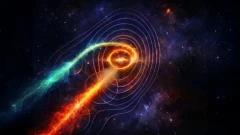
The most important aspect of this discovery is not the speed record itself. Because S301 passes so close to Sagittarius A*, its orbit should be noticeably affected by one of the predictions of Einstein’s general theory of relativity—the Lense–Thirring effect, or frame dragging. A rotating black hole drags spacetime along with it, gradually altering the orientation of the star’s orbit.
Scientists expect that within one or two decades, after tracking S301 through two complete revolutions, they will be able to directly measure the spin rate of the supermassive black hole at the centre of our galaxy. The star’s next close encounter with the black hole is expected in 2031.
"For the first time, we will have the opportunity to measure the spin of a massive black hole in a very direct way. This will be a key test of Einstein’s theory," said co‑author Stefan Gillessen.
What comes next
Astronomers will continue observations with the upgraded GRAVITY+ instrument, and later with the under‑construction Extremely Large Telescope (ELT). The more precisely they can track the changes in S301’s orbit, the better we will understand the properties of the Milky Way’s central black hole.
The findings were published on 19 August 2026 in the journal Nature.
In brief
Astronomers have discovered the fastest known star in the Milky Way—S301. It races around the supermassive black hole Sagittarius A* at 25,000 km/s (more than 8% of the speed of light) and approaches to within just 12 astronomical units. Thanks to this exceptionally tight orbit, scientists hope to measure the black hole's rotation directly for the first time in the coming years, and to put the predictions of general relativity to the test.