make preferable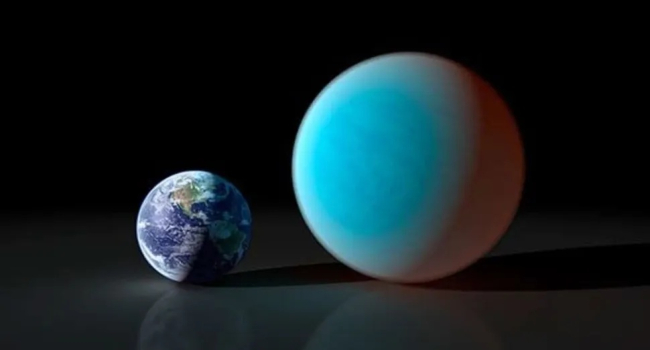
Astronomers have discovered an unusually massive and dense exoplanet that does not fit neatly into conventional models of rocky world formation. The object has been designated GJ 523b.
What is known about the planet
GJ 523b is roughly 2.5 times wider than Earth, yet about 23 times more massive. Because of its density, it falls into the informal category of "mega‑Earths"—unusually heavy, predominantly rocky planets. Despite its size, the object appears to have relatively little atmosphere; bodies of this mass would ordinarily have accumulated a thick gaseous envelope.
"This is not at all what we expected," said lead author Max Croft. "Dense planets are not rare, but they are usually small rocky worlds like Earth or Mercury. This planet is two and a half times larger than Earth."
The planet was first detected by the TESS satellite through periodic dimming of its host star. Follow‑up observations with the ground‑based WIYN telescope then measured the object's gravitational influence on the star. The resulting mass is estimated at about 23.5 Earth masses, with a radius of 2.55 Earth radii, giving it a very high density. The planet orbits its star every 17.75 days. The system itself is relatively young—about 170 million years old.
Why it is a puzzle
According to standard models, planets first accumulate rocky and metallic cores and then, once they reach about 20 Earth masses, begin to rapidly accrete hydrogen and helium. GJ 523b has already passed this threshold but has remained predominantly rocky.
"The question is, why didn't this planet do that, if it is 20 times more massive than Earth?" Croft asks.
Possible explanations vary. Either the planet once had a dense atmosphere that was later stripped away, or it formed from the collision of two worlds: the rocky parts merged while the gaseous envelopes were ejected.
How rare are such objects?
The term "mega‑Earth" has been used for over a decade, but it has never become an official exoplanet class. To understand how common such worlds are, more discoveries are needed.
"It's difficult to draw conclusions about planet formation in general from a sample of one," Croft said. "We won't get ten thousand of these ultra‑dense planets, but if we get to 20 or 30, perhaps some patterns will emerge."
The study is currently available as a preprint and has not yet undergone peer review.
In brief
Astronomers have found exoplanet GJ 523b—a rocky world roughly 2.5 times larger than Earth and 23 times more massive. Such density at such a large size contradicts standard formation scenarios: the planet should have accumulated a thick atmosphere but appears to have remained mostly rocky. Possible causes include atmospheric loss or a collision between two planets. More such objects are needed to understand the phenomenon.