make preferable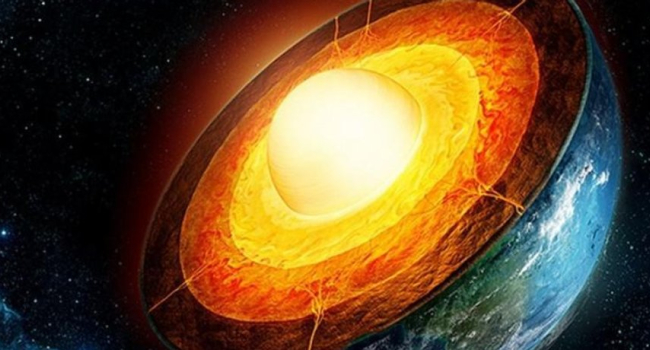
The idea of sending a research probe to the center of the Earth sounds like science fiction. Jules Verne described such a journey back in the 19th century, and over a hundred years later, a similar scenario appeared in the Hollywood film The Core. However, American geophysicist David Stevenson has now proposed a theoretically feasible way to penetrate the planet's depths.
As Science reports, the plan by the Caltech planetary geophysicist was not to attempt to send a person into Earth's interior, but rather to create a small autonomous probe capable of reaching the outer core on its own and transmitting data back to the surface.
An explosion and a billion kilograms of iron
The main obstacle to any journey to the center of the Earth is the extreme pressure and temperature. Stevenson therefore proposed first creating a crack in the Earth's crust using a powerful explosion.
According to his calculations, a blast of several megatons of TNT equivalent—roughly comparable to a magnitude 7 earthquake—could briefly split the upper layer of the crust. A huge amount of molten iron would then be poured into the resulting fissure.
The iron itself would act as a kind of "elevator" for the research probe. Under the force of gravity and its own weight, the molten metal would widen the crack and force it to propagate downward. According to the scientist's calculations, the channel would be about 12 centimetres wide and would advance at roughly 5 metres per second.
Through the Earth's crust, which is about 15 kilometres thick, such a crack would pass in less than an hour. It would then continue through the mantle, taking roughly a week.
This would require between 100 million and 10 billion kilograms of molten iron. At first glance, the quantity seems staggering, but Stevenson noted that the global metallurgical industry could theoretically produce that volume in about a week.
A grapefruit‑sized probe
The research probe itself was designed to be small—about the size of a grapefruit. It would need to be made from metal alloys with a melting point close to that of the molten material in Earth's outer core.
Stevenson acknowledged that the probe would probably not be able to operate for long after reaching the core. However, even a brief period might be enough to carry out unique measurements.
The probe's primary task would be to gather information on the composition and properties of Earth's deep layers and transmit it back to the surface. Sound waves—a kind of underground analogue of sonar—were proposed as a means of communication.
If such an experiment could be carried out, scientists would for the first time obtain direct data from regions of the planet that are currently studied almost exclusively by indirect methods.
Why it hasn't happened yet
Even the author of the idea understood that there is a vast gap between a theoretical calculation and an actual mission. The cost of the required amount of iron alone was estimated at hundreds of millions of dollars. Moreover, using a nuclear explosion to create the crack would pose a separate political and legal challenge.
But the main obstacle remained the probe itself. It would have to withstand colossal pressure and temperature, travel thousands of kilometres under extreme conditions, and simultaneously transmit information back to the surface.
Petrologist Dave Walker of the Lamont‑Doherty Earth Observatory noted that dismissing Stevenson's proposal simply because of its unconventionality would be a mistake. In his view, the idea of using molten iron to penetrate the Earth's depths could be feasible. However, building a probe capable of surviving the journey and returning scientific data remained the most serious challenge.
Nevertheless, Stevenson's concept stands as an interesting example of how modern geophysics is trying to solve one of science's most difficult problems: obtaining direct information about the internal structure of our planet.