make preferable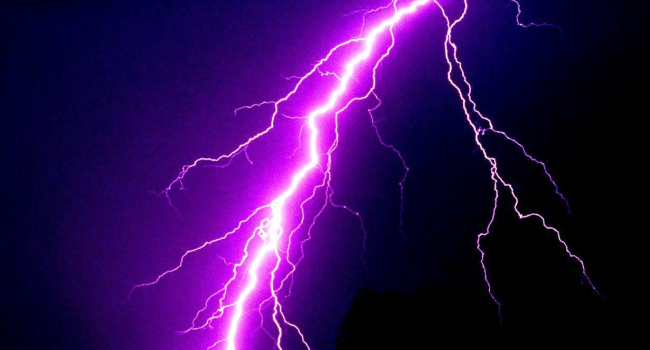
Lightning seems like an instantaneous flash in the sky, but in reality, behind it lies a complex process of electric charge separation inside a storm cloud. Within seconds, a powerful electric field forms in the atmosphere, ultimately leading to a giant electrical discharge.
It all begins with ice
Cumulonimbus clouds — giant atmospheric systems inside which water, ice, and hail are constantly moving — play the main role in lightning formation.
Strong updrafts lift small water droplets to the upper part of the cloud. There they freeze, turning into tiny ice particles. Some of them continue to grow and transform into larger hailstones.
When the hail becomes too heavy, the updraft can no longer support it, and the ice particles begin to fall downward. On their way, they collide with smaller ice particles.
It is these collisions that become the first step toward the appearance of lightning.
How a cloud turns into a huge battery
During collisions between particles, electrons are redistributed. Large hailstones acquire a negative charge, while small ice particles that lost electrons become positively charged.
Updrafts continue to lift the light, positively charged particles upward. As a result, the upper part of the cloud gradually acquires a positive charge.
The heavier, negatively charged hail, on the contrary, sinks downward. Thus, a peculiar electrical system arises inside the cloud: the top becomes predominantly positive, and the bottom part becomes negative.
In effect, the storm cloud begins to act like a giant battery, with a powerful electric field forming between its opposite "poles."
Why lightning strikes the ground
The negative charge in the lower part of the cloud also affects the Earth's surface. Electrons in the ground are repelled by the cloud, so the surface and the objects located on it acquire a relatively positive charge.
However, air is a poor conductor of electricity. Therefore, the accumulated potential difference does not lead to a discharge immediately.
When the electric field becomes strong enough, the situation changes. Discharge channels — so-called stepped leaders — begin to spread downward from the base of the cloud. They move not continuously, but in separate steps, gradually carving a path to the ground.
In response, positive streamers rise from the Earth's surface to meet them. They originate especially actively on sharp and protruding objects — such as tall buildings, trees, or masts.
At the same time, it is not strictly necessary for lightning to strike the tallest object. What matters decisively is which of the rising streamers meets the descending channel first.
A lightning flash lasts fractions of a second
When the descending leader connects with one of the positive streamers, a conductive channel forms between the cloud and the ground. A huge electrical current passes through it.
It is this powerful return stroke that we perceive as a bright flash of lightning. Its speed can reach approximately 430 thousand kilometers per hour.
Moreover, what we call a single lightning bolt may actually consist of several separate current pulses following each other at intervals of just a few hundredths of a second. That is why some lightning strikes appear to flicker.
Lightning can occur not only between a cloud and the ground. An electrical discharge is capable of occurring inside a single cloud or between different cloud formations if a sufficiently large charge difference arises between them.
Why lightning heats the air hotter than the surface of the Sun
The electrical current of lightning passes through an extremely narrow air channel — usually just a few centimeters in diameter. Despite its narrow width, the temperature inside the channel rises almost instantaneously to approximately 30 thousand degrees Celsius. This is roughly five times hotter than the surface of the Sun.
It is this red-hot plasma channel that creates the dazzling blue-white flash we see during a thunderstorm. But it is also responsible for another familiar phenomenon — thunder. Such rapid heating of the air causes it to expand abruptly. A powerful shockwave is generated, which travels through the atmosphere and reaches our ears as thunder.
Therefore, lightning and thunder are actually two different manifestations of the exact same process: lightning shows us the energy of the electrical discharge, while thunder shows the consequences of the instantaneous heating of the surrounding air.
Based on materials from the channel “Met Office - Learn About Weather”