make preferable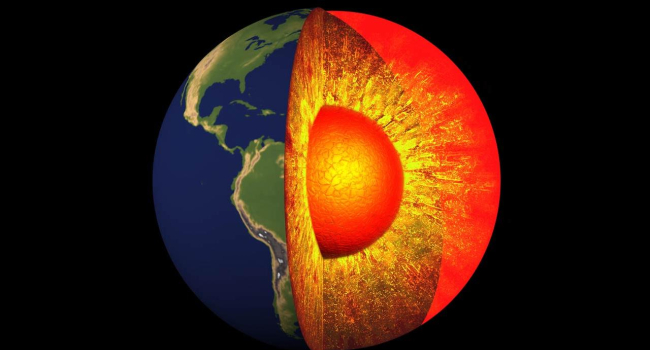
American researchers have modelled the behaviour of hydrogen in Earth's inner core and concluded that a so-called superionic hydrogen may exist there. This substance can flow like a liquid while simultaneously conducting electricity. The findings were published in the journal PNAS.
What superionic hydrogen is
The scientists examined two crystal structures of an iron‑hydrogen alloy: hexagonal close‑packed (HCP) and body‑centred cubic (BCC). Under ordinary conditions, the BCC structure is less stable and more reactive. It becomes relatively stable only at temperatures above 6,400 kelvin, with hydrogen content of 20% or more, and at pressures around 3.6 million atmospheres. However, according to the authors' calculations, such extreme conditions would more likely cause the material to melt entirely than to retain an ordered structure.
For this reason, the researchers consider the existence of a superionic hydrogen phase in the HCP structure to be more probable. It could coexist with the liquid material of the outer core.
Gradient and geodynamo
The modelling also revealed a radial gradient in hydrogen concentration: its amount drops sharply at the boundary between the outer and inner core. The exchange of the element between layers is not limited to the crystallisation process alone. There is a continuous redistribution of hydrogen, which creates so‑called chemical buoyancy. This helps sustain the geodynamo — the mechanism that generates Earth's magnetic field.
The planet's inner core grows by about one millimetre per year. According to the researchers, the distribution of hydrogen between layers is determined primarily by temperature rather than pressure.
In brief
Scientists have modelled the state of hydrogen in Earth's inner core and suggested the existence of a superionic phase there — a substance that flows like a liquid but conducts electricity. The most likely structure for this phase proved to be a hexagonal close‑packed lattice. The redistribution of hydrogen between the core layers may help sustain the geodynamo and the planet's magnetic field. The work was published in the journal PNAS.