make preferable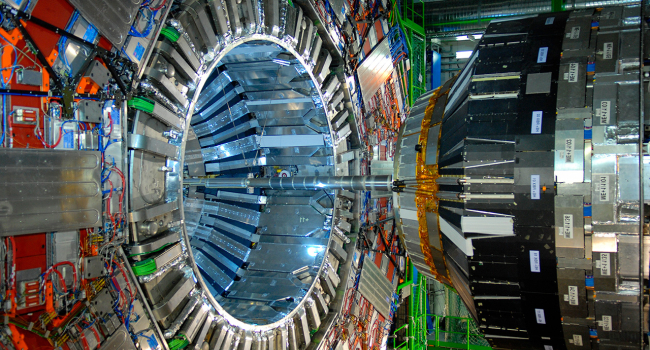
Physicists Xinyu Liang and Ariel Zhitnitsky from the University of British Columbia have put forward an unusual hypothesis: the mysterious glitches at the Large Hadron Collider (LHC) may be an indirect sign of dark matter passing near the accelerator. The work has been accepted for publication in the journal Physical Review D.
What UFOs are at the collider
For years, strange signals have been recorded inside the LHC, which physicists call UFOs — "unidentified falling objects." These are sudden losses of the proton beam. They are usually attributed to microscopic dust particles falling into the beam. However, the question remains: what exactly shakes this dust loose inside one of the cleanest and most precise scientific instruments?
The dark matter hypothesis
According to the authors, the cause could be axion-quark nuggets (AQNs) — a hypothetical form of dark matter. These are dense macroscopic objects with a mass of up to a kilogram. If such an object passes through the Earth within about 100 kilometers of the collider, the weak acoustic shock wave it generates could theoretically cause a barely perceptible vibration in the accelerator. This could be enough to shake dust particles into the proton beam and trigger a glitch.
The researchers explained that the LHC can be thought of as a giant and extremely fragile Swiss watch that continues to tick despite countless minor disturbances around it. In their model, a dark matter fragment passing through the Earth tens of kilometers away could create a tiny vibration — like a gentle tap on the table beneath a watch.
How to test the hypothesis
According to the physicists' calculations, such events should leave a characteristic "fingerprint": three or more correlated glitches within two seconds at consecutive points along the 27-kilometer tunnel. The signal strength should be about five times higher than background noise.
No new equipment is needed for testing — the LHC already has a beam monitoring system. The authors suggest re-examining archival glitch data for such a fingerprint. In the future, a similar approach could be applied to other large accelerators, creating a network of acoustic dark matter detectors.
In brief
Canadian physicists have suggested that strange glitches at the Large Hadron Collider could be linked to the passage of hypothetical dark matter objects — axion-quark nuggets. A weak shock wave from such objects could shake dust into the proton beam. A characteristic sign would be several correlated glitches within a short time. The hypothesis can be tested using archival beam monitoring data. The work has been accepted for publication in the journal Physical Review D.