make preferable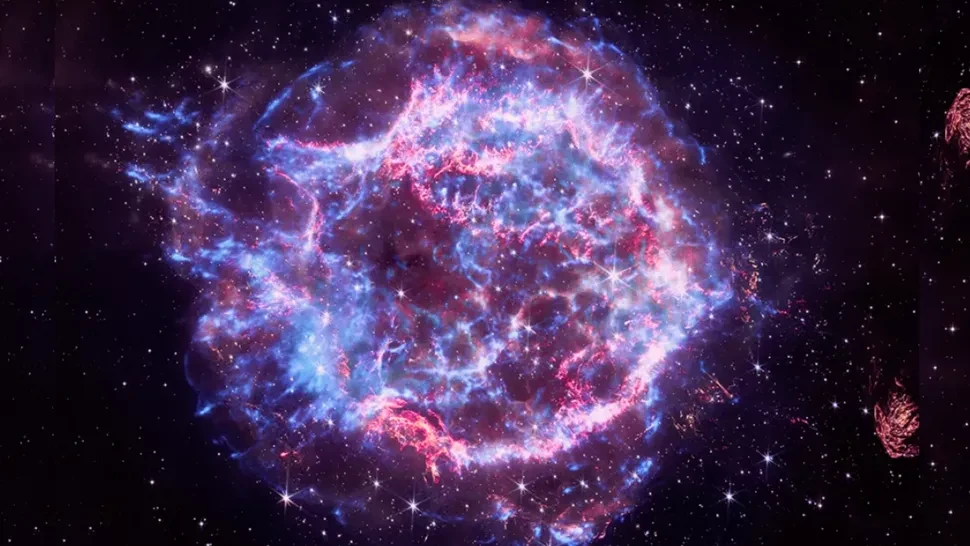
Some stars that had been considered evidence of hypernovae — explosions capable of releasing ten times more energy than ordinary supernovae — may have formed after far less powerful events. That is the conclusion reached by researchers at University College London (UCL). In their view, the unusual chemical composition of these stars is explained not by the extreme force of the explosion, but by the fact that matter in an ordinary supernova is ejected unevenly in different directions.
Why scientists proposed the existence of hypernovae
Supernovae occur at the end of the lives of massive stars. When the fuel for thermonuclear reactions runs out in their interiors, the core collapses and shock waves trigger a powerful explosion. Chemical elements formed inside the star are then ejected into the surrounding space.
Hypernovae were proposed to explain the origin of some stars with unusual chemical compositions. It was assumed that forming such objects required explosions about ten times more powerful than ordinary supernovae. These could occur when especially massive, rapidly rotating stars died.
The chemical composition of stars does indeed make it possible to investigate their origins: matter expelled in explosions mixes with interstellar gas and later becomes the building material for new generations of stars.
However, there is an important feature in this picture. Matter in an explosion is not necessarily distributed evenly, which means that the composition of the cloud from which a new star formed may differ greatly from the average chemical composition of the dead star.
An uneven explosion changes the chemical signature
The researchers developed mathematical models that take into account that different chemical elements can be ejected in different directions. For example, oxygen may fly predominantly in one direction, while sulfur may go in another. A new star then forms from a mixture of only part of the expelled matter, rather than from all the material of the supernova.
“We found that in all the cases we examined, stars with unusual combinations of elements were more likely to have formed from the matter of ordinary supernovae,” said study leader Anmol Aggarwal of UCL.
The team began by analyzing four stars that had previously been considered possible products of hypernovae. According to the scientists’ calculations, three of them most likely formed after ordinary supernovae.
The researchers then studied a red giant on the outskirts of the Milky Way. Its composition contained unusually large amounts of heavy elements, including silver and uranium. Such elements cannot be produced in sufficient quantities in the cores of most stars.
One possible explanation was the merger of two neutron stars — extremely dense remnants of dead stars. But the red giant’s chemical composition did not fully match the expected set of elements after such an event.
How the star ended up on the outskirts of the Milky Way
To explain the origin of the red giant, the scientists used a model of the Milky Way in which heavy elements accumulated thanks to the deaths of the first generations of stars.
According to the researchers, the star may have been born in a small galaxy with a low abundance of heavy elements, and then ended up on the outskirts of the Milky Way when that galaxy was absorbed by ours. Its rapid rotation and location point to such a history.
The model suggests that the star’s chemical composition was shaped by a combination of two events: a neutron star merger and an ordinary supernova. A hypernova is not required for this.
At the same time, the scientists do not claim that hypernovae do not exist in nature. Their conclusion is much more cautious: the unusual chemical composition of stars, which was previously considered evidence of such explosions, does not by itself prove that hypernovae actually occurred.
What this changes in the study of galaxies
The work shows how important it is to take into account the incomplete mixing of matter after stellar explosions. If different elements are distributed unevenly through space, the chemical composition of individual stars can mislead astronomers when reconstructing their origins.
According to UCL researcher Ralph Schönrich, scientists still do not fully understand how well supernova matter mixes before new stars form from it. Despite decades of research, this process remains uncertain.
The results may help refine models of the chemical evolution of galaxies and the behavior of the interstellar medium. The work was published in two papers in the journal Monthly Notices of the Royal Astronomical Society.
The study’s main conclusion is not that the most powerful stellar explosions turned out to be fiction, but that some of the supposed evidence for their existence can be explained by more familiar astrophysical processes.