make preferable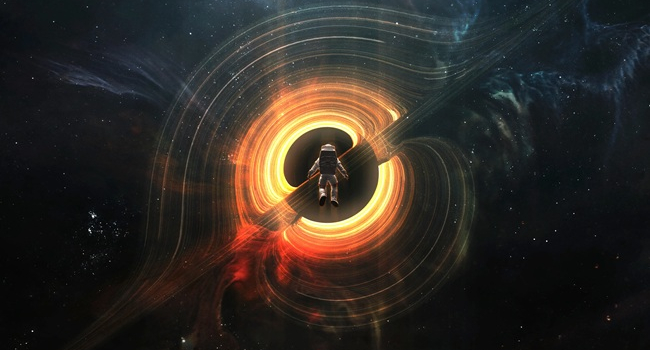
Black holes remain among the most mysterious objects in the Universe. Their gravity is so strong that even light cannot escape their boundaries. Falling into a black hole is a journey with no return. However, contrary to the common belief that only darkness and instant death await a person inside, the falling process would actually be far more unusual. According to modern physics, even before reaching the center of a black hole, a body would encounter extreme tidal forces that would literally stretch it beyond recognition.
What a black hole is
A black hole is a region of spacetime from which nothing can escape after crossing a certain boundary called the event horizon.
At the same time, the event horizon is not a physical wall or surface. It is an invisible boundary existing within spacetime itself. Once it is crossed, there is only one path left—toward the center of the black hole.
The reason is that the speed required to overcome gravity at the event horizon exceeds the speed of light. Since nothing can travel faster than light, leaving a black hole after crossing this boundary is impossible.
What a person would feel when approaching
Even before crossing the event horizon, a person would experience so-called tidal forces.
If falling feet first, the gravitational pull acting on the feet becomes significantly stronger than that on the upper body. Due to this difference, the body begins to gradually stretch in the vertical direction.
As one gets closer to the black hole, the difference in gravitational pull becomes ever greater. Simultaneously, different parts of the body begin to experience different gravitational effects in other directions as well, leading to even greater deformation.
Similar tidal forces exist on Earth—they are what cause ocean tides. However, near a black hole, their power increases by thousands or even millions of times.
Spaghettification—one of the most unusual effects
Under the influence of colossal tidal forces, the human body would literally begin to be torn apart at the atomic level, turning into a long and extremely thin strand.
This exact process earned the name "spaghettification," as the stretched body comes to resemble a long strand of spaghetti.
Physicists believe this effect is inevitable for any object approaching most black holes.
The size of the black hole matters
Interestingly, the consequences depend on the mass of the black hole itself.
If a person were near a stellar-mass black hole with a mass roughly ten times that of the Sun, the tidal forces would be so powerful that the body would be destroyed almost instantly.
In the case of a supermassive black hole with a mass roughly a million times that of the Sun, the process would unfold differently. A person would stretch by more than 12 meters before the body was ultimately destroyed by gravity.
In any of these scenarios, there is no chance of survival.
Why a person is not simply crushed
At first glance, it might seem that immense gravity should instantly flatten a person.
However, gravitational force depends not only on the mass of the black hole, but also on the distance to it.
Since the mass of a black hole is concentrated in an extremely small volume, the difference in gravitational pull between different parts of the body is enormous. It is precisely this difference that causes stretching.
In other words, the feet experience a significantly stronger pull than the head, causing the body to elongate rather than simply compress into a single plane.
What lies at the center
After passing through the event horizon, a person would inevitably continue moving toward the center of the black hole—the singularity.
According to modern physics, a singularity represents a point of infinite density where the familiar laws of nature cease to function.
Scientists do not yet know what exactly happens in this region. Current theories are unable to describe the processes inside a singularity, so it remains one of the main unsolved mysteries of modern science.
The possibility of survival
Based on current scientific understanding, surviving a fall into a black hole is impossible.
Long before reaching its center, a person would be destroyed by the extreme tidal forces causing spaghettification. And what happens after reaching the singularity remains unknown, as the existing laws of physics do not allow us to reliably describe events in this region of spacetime.