make preferable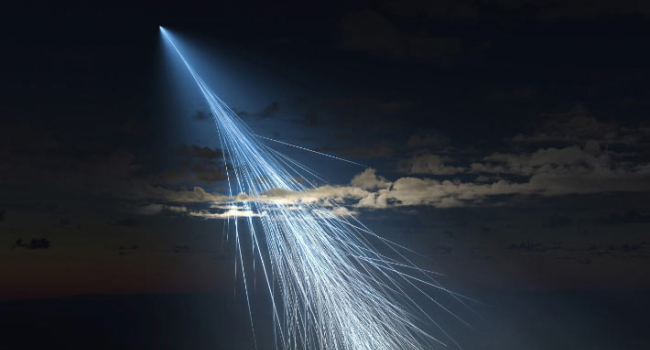
An international group of scientists from the University of Pennsylvania has proposed a mechanism that could reveal the origin of the Amaterasu particle — one of the most mysterious and energetic objects ever recorded in cosmic rays. According to their calculations, such particles arise from the acceleration of heavy atomic nuclei in extreme astrophysical conditions.
The work was published in the journal Physical Review Letters (PRL).
The mystery of record-breaking energy
The Amaterasu particle was detected in 2021 by the Telescope Array detector system over the southwestern United States. Its energy reached 244 exa-electronvolts — a fantastic magnitude. For comparison: this energy is equivalent to the kinetic energy of a tennis ball moving at 150 km/h, but concentrated in a single subatomic particle.
The direction from which the particle arrived did not point to any known astrophysical source, which left physicists perplexed.
A new acceleration mechanism
Physicist Kohta Murase and his colleagues developed a model according to which the source of such particles could be ultra-heavy nuclei — atoms heavier than iron (for example, lead or uranium). These nuclei are accelerated in powerful objects such as active galactic nuclei or galaxy clusters.
When interacting with photons of ambient radiation, photonuclear reactions occur: the heavy nuclei are partially destroyed, releasing individual nucleons (protons and neutrons) with colossal kinetic energy.
The model is in good agreement with observational data. It also explains why the exact source of the Amaterasu particle could not be identified: scattering in intergalactic magnetic fields blurs the arrival direction.
Significance of the discovery
The proposed mechanism helps to understand how particles of record-breaking energy can be born in the Universe and provides a new perspective on the processes occurring in the most extreme astrophysical objects.
The authors note that the hypothesis can be tested through future observations of galaxy clusters in the gamma-ray range and with next-generation neutrino telescopes.
In brief
Scientists at the University of Pennsylvania have proposed a mechanism explaining the origin of the Amaterasu particle — one of the most energetic ever recorded. According to their model, such particles arise from the acceleration of heavy nuclei (heavier than iron) in active galactic nuclei and galaxy clusters. Photonuclear reactions destroy the nuclei, releasing ultra-energetic nucleons. This is the first convincing explanation of the nature of record-breaking cosmic rays. The work was published in Physical Review Letters.