make preferable
Theoretical physicists have proposed a new scenario that could radically change our understanding of the final stages of massive stars' lives. According to calculations, during gravitational collapse, a miniature new Universe could be born inside a star, with its expansion preventing the formation of a black hole.
The work was published in the journal Physical Review D.
Gravastars instead of black holes
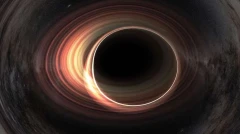
Black holes are considered the inevitable endpoint of very massive stars' lives. When nuclear fuel runs out, gravity takes over and the star collapses to a point of infinite density — a singularity. However, at this point, modern physical theories cease to work.
One alternative is gravastars. These objects are externally almost indistinguishable from black holes: they have the same mass and create a similar gravitational field. But inside them, there is no singularity. Instead, there is a region of high-density dark energy that creates pressure counteracting complete collapse.
Until now, the main problem with the hypothesis remained the question: how exactly could such objects form?
A new dynamic scenario
Daniel Yampolsky and Luciano Rezzolla have for the first time solved the equations of general relativity in a dynamic regime and demonstrated a realistic mechanism for gravastar formation.
According to their model, in the final stages of compression inside a dying star, a process resembling the Big Bang could begin. A new mini-Universe is born and begins to expand under the influence of dark energy. This internal expansion creates outward-directed pressure that stops the collapse before an event horizon forms.
Yampolsky noted that the Big Bang of the emerging Universe could begin after the star has practically reached the state of a black hole.
Importance of the discovery
The authors emphasize that their work does not deny the existence of black holes. The latter still remain the simplest and most natural explanation for gravitational collapse. However, current knowledge about the behavior of matter at extreme densities is incomplete, so it is important to explore alternative scenarios as well.
Rezzolla emphasized that black holes still remain the simplest and most natural explanation for the consequences of gravitational collapse, but our knowledge of matter behavior at extreme densities remains incomplete, so it is important for scientists to explore more exotic scenarios as well.
In brief
Physicists have for the first time proposed a dynamic mechanism for the formation of gravastars — objects similar to black holes but without singularities. According to the model, a mini-Universe could be born inside a collapsing star, with its expansion creating pressure that stops complete collapse. This solution of the equations of general relativity opens a new direction in the study of the final stages of massive stars' evolution and the nature of the most extreme objects in the Universe.