make preferable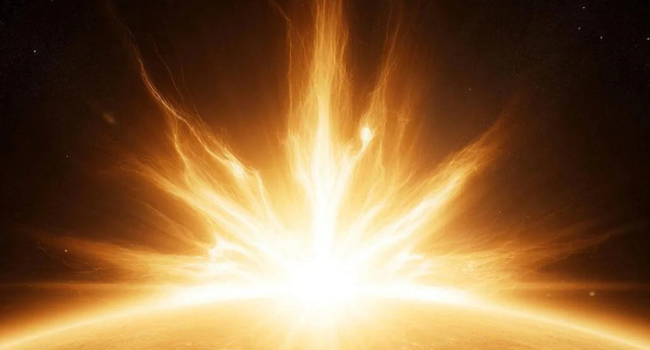
During the night of June 3, the Sun produced a powerful M9.3-class solar flare, the strongest flare recorded since April 24, 2026. The event was reported by the Solar Astronomy Laboratory of the Russian Academy of Sciences' Space Research Institute.
The flare was detected at 04:36 Moscow time (05:36 Yerevan time). It fell just short of reaching the highest X-class category, missing the threshold by approximately 7%. For comparison, on April 24 the Sun produced two X-class flares within a single day.
How the Situation Developed
Just a day earlier, solar activity had remained relatively calm. However, conditions began changing rapidly during the second half of June 2. Since then, new flares have been recorded roughly every seven hours, with their intensity gradually increasing.
Scientists do not rule out the possibility that an X-class flare could occur as early as midday on Wednesday.
Is the Flare Dangerous for Earth?
The flare occurred near the center of the visible solar disk, which is generally considered the most concerning position from Earth's perspective. If accompanied by a strong coronal mass ejection (CME), such an eruption could potentially be directed toward our planet.
At present, however, observational data do not indicate a significant plasma ejection heading toward Earth. Researchers at the Space Research Institute currently see no reason to consider this flare a threat to Earth's infrastructure or human health.
In Brief
A powerful M9.3-class solar flare—the strongest in about six weeks—was recorded on June 3. Although it erupted near the center of the Sun's visible disk, no major plasma ejection toward Earth has been detected so far. Solar activity continues to increase, and scientists believe an X-class flare may be possible in the coming hours.