make preferable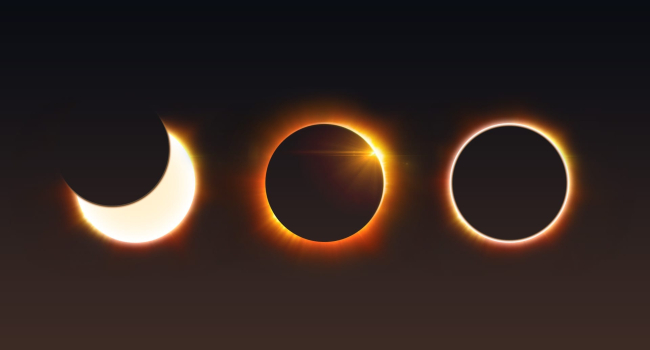
When the Moon, Earth, and Sun align in a straight line, one of the most spectacular celestial events occurs — an eclipse. Depending on the relative positions and distances between these bodies, eclipses can look very different. Astronomers identify seven main types, according to HowStuffWorks.
Solar eclipses
- Total solar eclipse
During a total solar eclipse, the Moon completely covers the Sun’s disk. Day suddenly turns dark, stars may become visible in the sky, and the Sun’s outer atmosphere — the corona — appears as a glowing halo around the Moon’s black silhouette. Such eclipses occur somewhere on Earth roughly every 18 months, but at any given location they are extremely rare, happening only once every 300–400 years. - Partial solar eclipse
The Moon covers only part of the Sun, making it look like a “bite” has been taken out of the solar disk. These events are significantly more common than total eclipses. - Annular (ring-shaped) solar eclipse
This occurs when the Moon is at the farthest point in its orbit and appears smaller than the Sun. As a result, a bright “ring of fire” remains visible around the dark lunar disk. No complete darkness occurs. - Hybrid solar eclipse
The rarest type of solar eclipse. Depending on the observer’s location on Earth, the same eclipse can appear total in some places and annular in others. This happens due to Earth’s curvature and variations in the Moon’s orbit.
Lunar eclipses
- Total lunar eclipse
Earth moves directly between the Sun and the Moon, casting its shadow (the umbra) onto the lunar surface. The Moon takes on a reddish-brown color, often called a “blood Moon.” This happens because sunlight is refracted through Earth’s atmosphere and reaches the Moon mainly in the red part of the spectrum. - Partial lunar eclipse
Only part of the Moon enters Earth’s umbra. One side of the Moon darkens noticeably while the other remains bright. - Penumbral lunar eclipse
The faintest and hardest to notice type. The Moon passes only through Earth’s outer shadow (penumbra), causing a very subtle dimming that many people may not even detect.
Why eclipses happen
Eclipses occur only because of the precise alignment of the Sun, Earth, and Moon. A solar eclipse happens when the Moon blocks the Sun from the perspective of observers on Earth, while a lunar eclipse occurs when Earth’s shadow falls on the Moon.
However, eclipses do not happen every new or full moon because the Moon’s orbit is slightly tilted relative to Earth’s orbit. As a result, perfect alignment is relatively rare.
In short
There are seven main types of eclipses: four solar (total, partial, annular, and hybrid) and three lunar (total, partial, and penumbral). Each has its own appearance and observing conditions. The most spectacular are total solar and total lunar eclipses, while hybrid solar eclipses are the rarest. These events beautifully demonstrate the complex celestial mechanics of the Solar System.