make preferable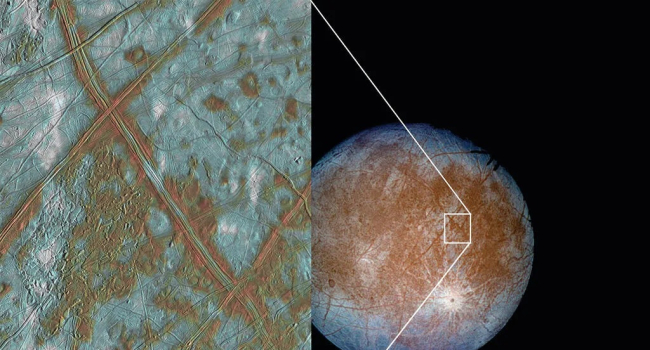
After reanalyzing years of observations, astronomers have significantly reduced their confidence that water vapor plumes exist on Europa, Jupiter’s icy moon. These eruptions had previously been considered one of the strongest indications of active interaction between Europa’s subsurface ocean and its surface.
The conclusion was reached by an international team of researchers who revisited 14 years of observations from the Hubble Space Telescope.
Revisiting old data
In 2014, a team led by Lorenz Roth of the KTH Royal Institute of Technology and Kurt Retherford of the Southwest Research Institute announced the possible discovery of water plumes on Europa.
At the time, the finding caused a sensation because the geysers were thought to eject water from a global salty ocean hidden beneath Europa’s thick icy crust.
The same scientists have now revised their conclusions.
Kurt Retherford stated that the evidence for water vapor plumes on Europa is not as convincing as the team originally believed.
What the new study found
The researchers analyzed archival data from the STIS spectrograph aboard the Hubble Space Telescope covering the period from 2012 to 2024. They focused on Lyman-alpha emission — an ultraviolet spectral line emitted by hydrogen atoms.
The team discovered that the interpretation of the data was extremely sensitive to Europa’s exact positioning in the images. Even a shift of one or two pixels could significantly alter the results.
The scientists concluded that the previously detected signals were most likely caused by noise in the data.
Lorenz Roth explained that the reanalysis reduced the original confidence level from 99.9% to below 90%, which is insufficient to confidently claim the existence of plumes.
What remains uncertain
Despite the weaker evidence, researchers are not completely ruling out the existence of plumes on Europa.
On Enceladus, similar water geysers have been confirmed much more reliably. In addition, powerful sulfur dioxide eruptions are regularly observed on Io, another moon of Jupiter.
The issue will most likely be settled by Europa Clipper, NASA’s upcoming mission scheduled to enter Jupiter’s orbit in 2030 and conduct a detailed investigation of Europa.
In brief
A new analysis of 14 years of Hubble Space Telescope observations suggests that evidence for water vapor plumes on Europa is significantly weaker than previously thought. The same scientists who first announced the possible discovery in 2014 have reduced their confidence level from 99.9% to below 90%. The question of whether Europa truly has active geysers — and how its underground ocean interacts with the surface — will likely remain unresolved until the arrival of Europa Clipper in 2030.