make preferable
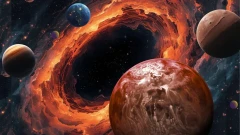
Physicists have proposed a radically new interpretation of the famous Einstein–Rosen bridges, which are usually associated with “wormholes.” According to a new study, these structures may not be tunnels through space at all, but rather connections between two opposite directions of time.
The research was published in Classical and Quantum Gravity and has already attracted significant interest within the scientific community.
From spatial tunnels to temporal bridges
Wormholes have long been a staple of science fiction — hypothetical tunnels allowing instantaneous travel between distant points in the Universe. However, the authors of the new paper point out that the original concept proposed by Albert Einstein and Nathan Rosen in 1935 was quite different.
At the time, the “Einstein–Rosen bridge” was introduced as a mathematical structure intended to describe the behavior of quantum fields in strong gravitational environments. Only later did researchers begin interpreting it as a wormhole, even though calculations suggested that such objects would be extremely unstable and collapse faster than even light could pass through them.
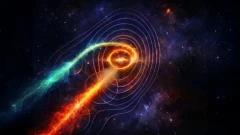
The new model abandons the spatial interpretation entirely. The scientists argue that an Einstein–Rosen bridge instead reflects a connection between two components of a quantum state: in one, time flows forward, while in the other, it flows backward relative to a mirror reflection.
Addressing key paradoxes in physics
This approach could open intriguing new possibilities. Most importantly, it may represent a significant step toward reconciling quantum mechanics with general relativity — one of the greatest unresolved problems in modern physics.
The model also offers an elegant solution to the black hole information paradox formulated by Stephen Hawking in 1974. If a black hole evaporates, what happens to the information about the matter that fell into it?
According to the new hypothesis, the information is not destroyed but continues to exist in the opposite direction of time. In this way, causality is preserved without requiring exotic new physics.
What comes next?
The research remains entirely theoretical and currently lacks direct observational evidence. Nevertheless, the authors suggest that traces of this “temporal” structure of the Universe could appear in relic phenomena that are today interpreted as Dark Matter.
The researchers concluded that wormholes may not be necessary at all: the bridge could be temporal rather than spatial, while the Big Bang would become not a beginning, but a transition.
If the hypothesis is eventually confirmed, it could fundamentally reshape our understanding of time, the structure of the Universe, and the processes that occurred during its earliest moments.
In brief
Physicists have proposed a new interpretation of Einstein–Rosen bridges, suggesting that these objects are not spatial tunnels but connections between streams of time flowing in opposite directions. The study, published in Classical and Quantum Gravity, could help bridge quantum mechanics and gravity while also offering a potential solution to the black hole information paradox. Although still theoretical, the model presents a radically new perspective on the nature of time and the Big Bang.