make preferable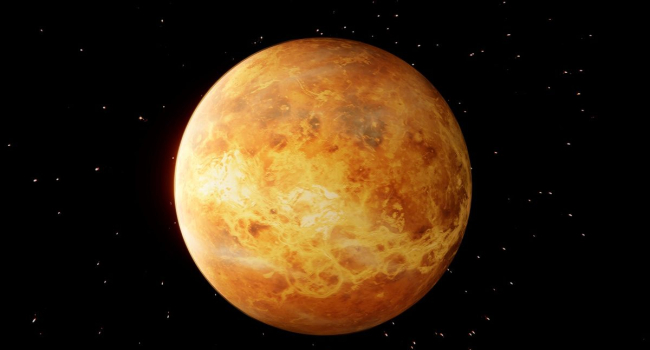
Imagine water pouring from a kitchen faucet into a sink. At first, it spreads out in a thin, fast-moving layer, but then it suddenly rises, slows down, and forms a visible circular ridge. That familiar effect is known as a hydraulic jump—and scientists now believe the same phenomenon, on a planetary scale, is responsible for one of the strangest atmospheric structures on Venus.
In 2016, Japan’s Akatsuki spacecraft detected a massive cloud band roughly 6,000 kilometers long circling Venus near the equator at an altitude of about 50 kilometers. The structure repeatedly wrapped around the planet every few days, and researchers struggled for years to explain its enormous size, sharp boundaries, and unusual speed. A new study may finally have solved the mystery.
What a hydraulic jump is
An international team led by Takeshi Imamura concluded that the cloud band is caused by a hydraulic jump—the largest ever identified anywhere in the Solar System.
A hydraulic jump occurs when a fast, relatively shallow flow of liquid or gas suddenly slows down and becomes deeper. On Earth, the effect can be seen not only in kitchen sinks, but also in rivers, canals, and certain waterfalls.
On Venus, however, the process unfolds inside an atmosphere composed mainly of carbon dioxide, with traces of sulfur compounds. A powerful planetary-scale Kelvin wave travels through the lower atmosphere along the equator. These enormous atmospheric waves stretch across thousands of kilometers and move eastward around the planet.
According to the researchers, when this wave slows down, it creates a hydraulic jump. The resulting upward motion is so strong that it lifts sulfuric acid vapor to altitudes of around 50 kilometers. There, the vapor condenses into thick clouds, forming the enormous cloud bank observed by Akatsuki. The clouds trail behind the front edge of the wave, creating the sharp atmospheric boundary seen in spacecraft images.
Why the discovery matters
Imamura said the team can now show that the disruption in Venus’s cloud cover is caused by the largest known hydraulic jump in the Solar System. He also noted that the finding was unexpected because it links a huge horizontal atmospheric process with an intense localized vertical wave—two phenomena that are not usually associated in fluid dynamics.
The discovery marks the first time a hydraulic jump has ever been identified on another planet. Researchers say the phenomenon behaves very differently from similar processes on Earth, highlighting just how unusual Venus’s atmosphere really is.
Venus is already known for its extreme atmospheric dynamics. Its atmosphere rotates around the planet far faster than the planet itself—a phenomenon called superrotation. While Venus takes 243 Earth days to complete one rotation, its atmosphere circles the planet in only about four days. Surface pressure reaches roughly 92 times that of Earth, and temperatures exceed 460°C.
Rethinking models of Venus’s atmosphere
Until now, most global climate models of Venus were built largely by analogy with Earth’s atmosphere and did not account for this kind of hydraulic jump. The new findings suggest those models may need significant revision.
Imamura explained that the next step will involve testing the discovery using more comprehensive climate simulations that include additional atmospheric processes. He noted that such work will require enormous computational power, posing major challenges even for modern supercomputers.
The study was published on April 24 in the scientific journal Journal of Geophysical Research: Planets.
In brief
Scientists believe a gigantic 6,000-kilometer band of sulfuric acid clouds high above Venus is created by the largest hydraulic jump ever observed in the Solar System. As a massive Kelvin wave slows in Venus’s atmosphere, it triggers a powerful upward flow that lifts sulfuric acid vapor into higher layers, where it condenses into clouds. A phenomenon familiar from an ordinary kitchen sink is therefore operating on a planetary scale on Venus—marking the first confirmed hydraulic jump beyond Earth and forcing scientists to rethink how the planet’s atmosphere behaves.