make preferable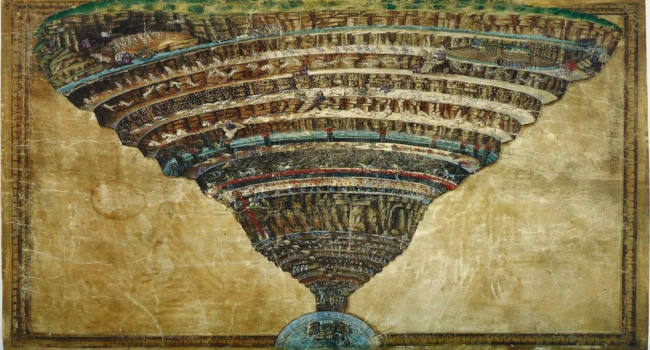
One of the masterpieces of medieval literature may contain a surprisingly detailed, almost modern-sounding depiction of what happens when a large celestial body strikes Earth. That is the conclusion reached by Professor Timothy Burberry of Marshall University in West Virginia, a scholar working at the intersection of literature and what is known as geomythology.
According to reporting by Space.com, Burberry suggests that Dante Alighieri’s Inferno—the first part of The Divine Comedy, written between roughly 1308 and 1321—contains imagery that closely resembles contemporary scientific models of a major asteroid or comet impact, particularly in its description of Lucifer’s fall from the heavens.
What geomythology is
Burberry, a professor of English literature, specializes in geomythology, a field that examines ancient myths, legends, and literary works for possible echoes of real geological events. From this perspective, he reinterprets key passages of Dante’s Inferno as potentially encoding a memory of catastrophic planetary-scale processes.
The structure of Inferno and its climax
In Dante’s narrative, the poet himself travels through the underworld under the guidance of the Roman poet Virgil. Their journey takes them across the river Styx with the help of Charon and through the nine concentric circles of Hell, each reserved for different categories of sin. Figures ranging from mythological and historical rulers to traitors and violent criminals are assigned to their respective punishments, with names such as Alexander the Great and Attila appearing among those condemned.
At the very center of the Earth lies the frozen lake of Cocytus, where Satan is depicted as a three-faced figure, the fallen archangel Lucifer. Each of his mouths eternally chews on one of the three greatest traitors in Dante’s moral universe: Judas Iscariot, Brutus, and Cassius.
Lucifer’s fall as a model of impact
The most intriguing aspect of Burberry’s interpretation concerns the poem’s final section. In order to escape Hell, Dante and Virgil descend along Lucifer’s massive body, pass through the Earth’s center, and emerge in the Southern Hemisphere near the base of Mount Purgatory.
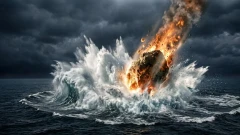
In the poem’s internal cosmology, Virgil explains that the Southern Hemisphere was once covered by land, but was transformed when God cast Lucifer down from Heaven. In this account, the falling angel strikes Earth at enormous speed, penetrates deep into the planet, and effectively carves out a vast structure that becomes Hell itself. The displaced material is said to have formed Mount Purgatory on the opposite side of the world, while the remaining surface reorganizes into the Earth’s present-day land distribution.
Burberry interprets this narrative as resembling a conceptual model of a high-energy impact event: a central crater reaching deep into the planet, terraced or ring-like structures corresponding to the circles of Hell, and an uplifted central peak analogous to a rebound mountain.
A medieval imagination ahead of its time
Burberry argues that, although Dante was not a scientist, he may have been among the earliest writers to seriously imagine the physical consequences of a massive object striking Earth at high speed. In his reading, the scale and velocity attributed to Lucifer effectively turn the event into a planetary impact capable of reshaping geography.
Such an idea would have been highly unusual for the early 14th century. At the time, celestial bodies were generally understood as perfect and unchanging, and the concept of objects falling from space and colliding with Earth was not part of accepted natural philosophy. Even meteorites were not widely recognized as extraterrestrial in origin until the 19th century.
Burberry further suggests that, in terms of scale, the hypothetical impact implied by Dante’s imagery could be compared—at least conceptually—to the kind of catastrophic events associated with mass extinctions such as the one that ended the age of dinosaurs 66 million years ago, or even the far earlier impact processes that may have contributed to the formation of the Moon about 4.5 billion years ago.
The value of geomythology
Whether or not Dante intended any reference to an actual asteroid impact, Burberry’s interpretation highlights the broader value of geomythology. It suggests that ancient texts can sometimes preserve intuitive or symbolic understandings of natural disasters long before the development of modern scientific frameworks.
The research was presented as a poster at the General Assembly of the European Geosciences Union (EGU) in Vienna in May.
In brief
A Marshall University professor argues that Dante’s Inferno may encode an ancient narrative resembling a giant asteroid impact. In this reading, Lucifer’s fall creates a multi-ringed structure corresponding to the circles of Hell, a central uplift resembling Mount Purgatory, and a redistribution of Earth’s landmasses—features that loosely parallel modern models of large impact events. This interpretation positions The Divine Comedy as an unexpectedly early literary attempt to imagine the full physical consequences of a massive collision between Earth and a celestial body.