make preferable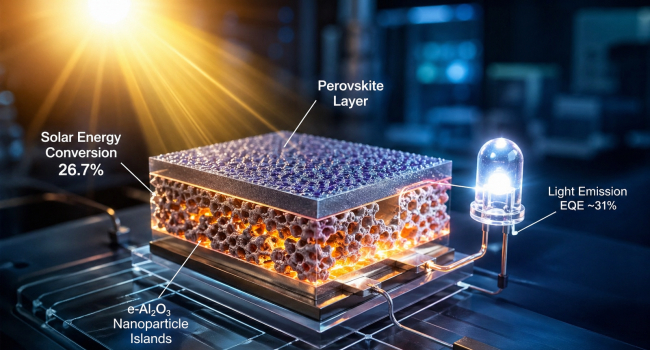
A single perovskite-based device has set world records simultaneously in solar energy conversion and light emission—a feat previously achieved only with expensive single-crystal gallium arsenide.
The study, published in the journal Joule, describes a diode that converts sunlight into electricity with 26.7% efficiency and emits light with an external quantum efficiency of about 31%. This proves that the long-standing contradiction between the design of photovoltaic devices and LEDs is an engineering challenge rather than a fundamental physical limitation.
Bridging Two Worlds
The research was led by Michael McGehee of the University of Colorado Boulder and Jixian Xu of the University of Science and Technology of China. Metal-halide perovskites have long shown promise for both solar cells and LEDs, but these two applications impose opposing design requirements. Efficient LEDs require thin, discontinuous perovskite layers about 50 nanometers thick to scatter light outward, whereas solar cells need layers roughly sixteen times thicker to absorb enough solar radiation. Historically, devices attempting to combine both properties failed to perform well in either.
The team solved this by developing porous, sponge-like "islands" of aluminum oxide nanoparticles—known as e-Al₂O₃—embedded within the perovskite layer. Two groups of alumina nanoparticles were given opposite surface charges, causing them to self-assemble into micrometer-sized structures. Because the islands are porous, the perovskite grows through them, maintaining electrical contact while simultaneously redirecting trapped light outward.
Record-Breaking Performance
The molecules used to charge the alumina particles also passivate defects in the perovskite, reducing the rate of electrical charge loss at interfaces to levels comparable to high-efficiency silicon solar cells. This suppression of defect loss enables "photon recycling": trapped photons are reabsorbed and re-emitted with a higher probability of escaping the device.
In solar cell mode, the device achieved an externally certified stabilized power conversion efficiency of 26.7%—a figure that held the world record for single-junction perovskite devices from May 2024 to February 2025. In LED mode, using the same 800-nanometer-thick perovskite layer, the device reached an external quantum efficiency of about 31%, with brightness nearly ten times higher than a flat control device. Furthermore, the device retained 95% of its initial solar cell efficiency after 1,200 hours of continuous operation, compared to just 67% for the flat control sample.
From Lab to Application
The practical implications extend far beyond the laboratory. Displays that harvest ambient light in standby mode or lighting systems that recoup energy when inactive become increasingly realistic when a single device architecture performs both functions without significant compromise. The authors note that this is only the second time any photovoltaic material in a polycrystalline device has simultaneously exceeded 26% efficiency in solar energy and 30% efficiency in LED mode—the first being gallium arsenide, which is significantly more expensive and difficult to manufacture at scale.