make preferable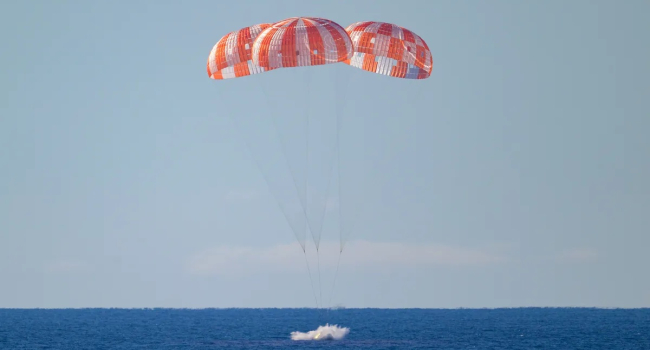
The NASA spacecraft Orion spacecraft carrying the Artemis 2 mission crew successfully splashed down in the Pacific Ocean off the coast of San Diego on the evening of April 10, 2026. The landing marked the completion of humanity’s first crewed mission to cislunar space in more than half a century.
The Journey Home
Four astronauts — commander Reid Wiseman, pilot Victor Glover, mission specialist Christina Koch (all from NASA), and Jeremy Hansen from the Canadian Space Agency — spent ten days in space. During that time, they orbited the Moon, set a new distance record from Earth, and successfully completed all major objectives of the test mission.
A NASA representative stated after splashdown that from the pages of Jules Verne to a modern mission to the Moon, a new chapter in exploring Earth’s celestial neighbor had come to an end, noting that the astronauts aboard the capsule Integrity had safely returned to Earth.
A Mission of Firsts
Artemis 2 launched on April 1 and became a major milestone in the history of spaceflight. It marked:
- the first crewed flight of the Space Launch System (SLS);
- the first crewed mission aboard the Orion spacecraft;
- the first return of humans to cislunar space since Apollo 17 mission in December 1972.
The crew also set several notable firsts:
- Victor Glover became the first Black astronaut to travel beyond low Earth orbit;
- Christina Koch became the first woman to reach such a distance from Earth;
- Jeremy Hansen became the first non-American to travel that far into space.
The head of the Artemis program noted that four outstanding individuals had been sent to the Moon and safely brought back to Earth for the first time in more than fifty years.
Meanwhile, Jared Isaacman, who observed the recovery from the deck of the USS John P. Murtha, said he still struggled to find words and remarked that his younger self would hardly believe what he had just witnessed.
Record Distance and Scientific Observations
The Artemis 2 spacecraft followed a free-return trajectory that allowed the crew to travel a record 406,771 kilometers from Earth — farther than any humans had ever gone before. The previous record belonged to the crew of Apollo 13 mission.
From launch to landing, the crew traveled more than 1.1 million kilometers.
During the flyby, astronauts conducted detailed observations of the Moon’s surface, including regions on the far side never before seen directly by human eyes. Special attention was given to the Orientale Basin. The crew also witnessed a total solar eclipse lasting nearly 54 minutes, a phenomenon impossible to observe from Earth under the same conditions.
Technical Testing and Reentry
One of the mission’s key objectives was to test the Orion heat shield during atmospheric reentry. Following damage observed during the uncrewed Artemis 1 mission, engineers selected a steeper reentry angle for Artemis 2.
The capsule entered Earth’s atmosphere at roughly 38,600 km/h, endured several minutes inside a plasma “fireball” that temporarily cut communications, and successfully deployed its parachute system.
Splashdown proceeded smoothly, with the capsule touching the water at less than 32 km/h. The astronauts were reported to be in good health and in high spirits.
What Comes Next
Artemis 2 was a crucial test flight paving the way for more ambitious missions. The next stage will be Artemis 3 mission, scheduled for mid-2027, which will rehearse docking Orion with a lunar lander in Earth orbit.
It will be followed by Artemis 4 mission, expected in late 2028, when astronauts are planned to land near the Moon’s south pole.
A NASA deputy administrator emphasized that although the path to the lunar surface was now open, much work remained ahead, adding that while humanity left the Moon 53 years ago, this time the goal is to return and stay.
In Brief
On April 10, 2026, the Orion capsule carrying the Artemis 2 crew safely splashed down in the Pacific Ocean near San Diego, completing the first crewed mission to cislunar space in more than 53 years. The astronauts set a record distance from Earth, conducted unique lunar observations, and successfully tested spacecraft systems in deep space. The mission’s success paves the way for a human return to the lunar surface during Artemis 4 in 2028.