make preferable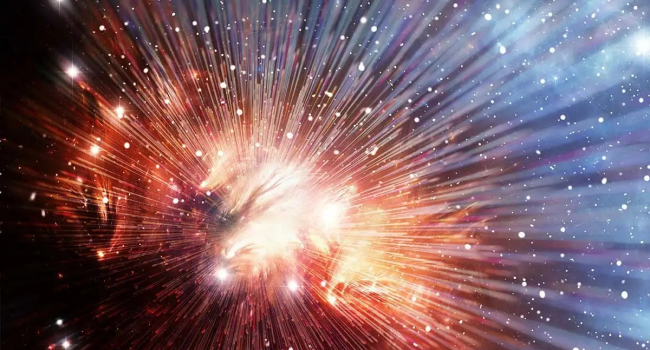
Dwarf galaxies—not giant star systems or supermassive black holes—were the primary “lamps” that ended the cosmic dark ages and made the Universe transparent. This is the conclusion reached by an international team of astronomers, whose study was published in Nature.
Cosmic Dawn and the Epoch of Reionization
Immediately after the Big Bang, the Universe was an opaque, hot plasma. About 300,000 years later, it cooled enough for protons and electrons to combine into neutral hydrogen. Light was finally able to travel freely, but there were almost no sources of radiation—marking the beginning of the so-called “dark ages.”
The situation changed with the formation of the first stars and galaxies. Their ultraviolet radiation began ionizing neutral hydrogen, stripping electrons from atoms. This process, known as reionization, lasted for about a billion years. By the end of it, the Universe became transparent, and “the lights turned on”—a period astronomers refer to as the cosmic dawn.
For a long time, scientists believed that massive, bright galaxies and active galactic nuclei powered by supermassive black holes were primarily responsible for reionization. However, new observations have reshaped this picture.
Dwarf Galaxies — The Hidden Heroes
The study was led by astrophysicist Hakim Atek. The researchers used a natural gravitational lens—a massive galaxy cluster known as Abell 2744—which magnifies the light of objects located far behind it. This made it possible to observe extremely faint and distant dwarf galaxies that had previously been beyond detection.
The results were surprising. Dwarf galaxies turned out to be about 100 times more numerous than large galaxies. Moreover, their combined ultraviolet output was found to be four times higher than earlier theoretical estimates.
Hakim Atek explained that these cosmic energy sources, taken together, emit more than enough energy to complete reionization, and that despite their small size, they have an enormous impact on the state of the entire Universe.
Why It Matters
Dwarf galaxies in the early Universe were far more numerous and active than previously thought. Their low mass and low metallicity allowed their stars to emit significantly more ionizing ultraviolet radiation. As a result, these small galaxies collectively managed to “pierce” the neutral hydrogen fog and make the cosmos transparent.
The study so far covers only a small patch of the sky within the field of view of the Abell 2744 lens. The findings still need to be confirmed with a broader dataset, including observations from the James Webb Space Telescope. Nevertheless, the work is already considered one of the most compelling explanations of the mechanism behind the cosmic dawn.
In Brief
Dwarf galaxies in the early Universe played a decisive role in the process of reionization. They produced enough ultraviolet radiation to ionize neutral hydrogen and effectively “turn on the lights” in the Universe roughly a billion years after the Big Bang. Observations using the galaxy cluster Abell 2744 as a gravitational lens revealed that such galaxies are far more numerous than large ones, and their combined radiation output greatly exceeds previous estimates. The study, published in Nature, reshapes our understanding of how the Universe emerged from its dark ages.