make preferable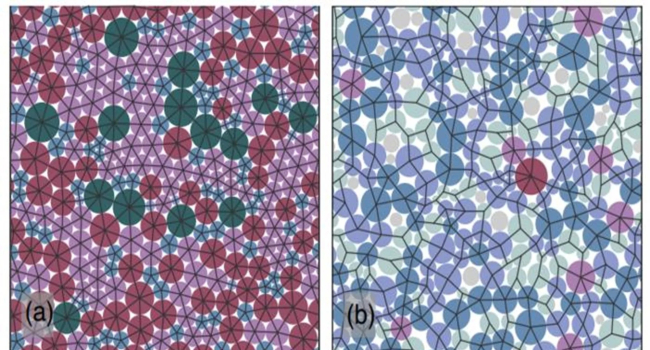
Researchers from the University of Oregon have developed the first computer model of so-called “ideal glass,” a state of matter that for decades was considered a fundamental paradox in physics.
The study, published in Physical Review Letters, shows that such a state can exist — at least in a two-dimensional system. The discovery could eventually lead to the creation of extremely strong and stable glass-like materials with unusual properties.
What “ideal glass” is and why it seemed impossible
Ordinary glass is an amorphous material: its atoms or molecules are arranged randomly, similar to a supercooled liquid, rather than in the repeating lattice structure typical of crystals. This disorder is what makes glass solid yet brittle and allows it to exist in many different particle configurations.
The idea of ideal glass dates back to 1948, when chemist Walter Kauzmann identified a theoretical problem now known as the Kauzmann paradox.
Kauzmann observed that when a liquid is cooled far below its freezing point, its entropy—a measure of disorder—drops faster than that of the corresponding crystal. In theory, the entropy could eventually reach zero, meaning the system would have only one possible configuration.
This raised a major question: how could a disordered, amorphous material have the same low entropy as an ordered crystal? For decades, physicists regarded this scenario as physically impossible.
Building ideal glass in a computer simulation
In the new study, physicists led by Eric Corwin used computer simulations of a two-dimensional system of particles (disks) that were allowed to change size during packing.
This approach resembles nonequilibrium techniques used to create ultra-stable glasses in real materials and helped bypass the limitations of traditional cooling methods.
The result was remarkable: researchers generated an amorphous structure with zero configurational entropy.
At first glance the arrangement appears random, but each particle has on average six contacts with its neighbors. This is nearly the same local arrangement found in a hexagonal crystal lattice, except the structure lacks long-range order.
Corwin explained that the team believes the paradox has effectively been resolved, demonstrating that such a state is not impossible but can actually be constructed.
Properties that could change material science
The simulated ideal glass shows unusually strong and stable behavior.
When mechanical stress is applied, vibrations move through the structure uniformly, almost like in a crystal, instead of scattering randomly as they do in ordinary glass. This makes the material much more resistant to deformation and fracture.
Importantly, such a state cannot be achieved through simple cooling of a liquid, because the relaxation time would become effectively infinite. However, the simulation demonstrates that nonequilibrium techniques—such as altering particle sizes or other packing strategies—can create the structure directly.
What comes next
So far, the model exists only in a two-dimensional system, but the researchers believe the underlying principles could extend to three-dimensional materials.
If that proves possible, it could open the door to entirely new classes of materials, including:
- ultra-strong glass
- highly stable coatings
- materials with unusual optical or mechanical properties
Such developments could impact fields ranging from nanotechnology to advanced manufacturing.
In brief
Physicists from the University of Oregon have created the first simulation of ideal glass, an amorphous material with zero configurational entropy that mechanically behaves like a crystal. The work resolves the long-standing Kauzmann paradox from 1948 and shows that such a state can be achieved using nonequilibrium methods in a two-dimensional particle system. Although the material has not yet been created in the real world, the model suggests a path toward extremely strong and stable glass materials in the future.