make preferable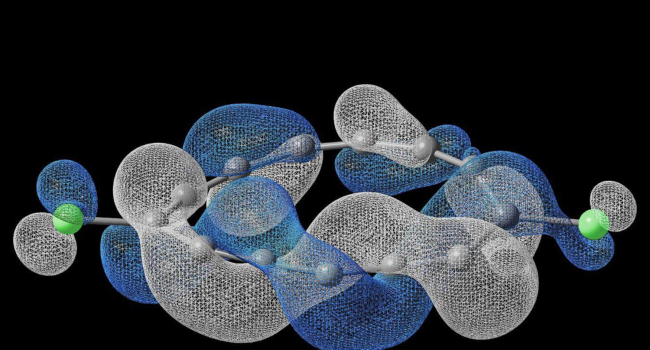
Researchers from the University of Manchester have synthesized a molecule with a unique topology that has never been observed in nature. Its structure is so unusual that it requires four full rotations to return to its starting point—even more complex than the famous Möbius strip, which requires only two.
The study was published in the journal Science.
What this molecule looks like
The molecule itself is surprisingly simple in composition: 13 carbon atoms and two chlorine atoms linked together in a ring. Yet its three-dimensional configuration is extremely unusual.
The researchers explain that if a hypothetical particle were to travel along the path of this molecule, it would have to circle the loop four times before returning to the same side of the structure.
This makes it the first known molecule with a topology requiring four turns. By comparison, a classic Möbius strip has only a single half-twist, meaning a traveler must go around the surface twice to reach the same orientation.
How scientists built it
The molecule was assembled on a thin gold surface at extremely low temperatures. The scientists manipulated atoms one at a time using:
- an atomic force microscope (AFM)
- a scanning tunneling microscope (STM)
In effect, the researchers constructed the molecule manually at the atomic level.
Its unusual twisted geometry arises from the behavior of electron waves. Electrons spread across the entire molecular structure and form complex interference patterns. These interactions force the ring into its unusual topology.
A molecule whose twist can be controlled
One of the most remarkable features of the molecule is that its topology can be actively switched.
By applying a small electromagnetic pulse, researchers were able to:
- flip the molecule’s twist from left-handed to right-handed
- completely untwist it into a flat ring
This ability suggests the molecule could serve as a molecular switch or building block for future nanodevices with controllable topology.
To analyze the molecule’s electronic behavior, scientists used both traditional supercomputers and an IBM quantum computer, which is particularly well suited for modeling complex electron interactions.
Why the discovery matters
The research demonstrates a new way of designing molecules with precisely controlled three-dimensional topology. In the future, such structures could play roles in:
- molecular sensors
- nanoelectronics
- quantum computing
- materials with unusual optical or mechanical properties
The discovery also shows that even small molecules composed of only a few dozen atoms can display topological effects previously thought to exist mainly in larger, macroscopic systems.
In brief
Chemists from the University of Manchester synthesized a molecule made of 13 carbon atoms and two chlorine atoms whose topology requires four full rotations to return to its starting point, making it more complex than a Möbius strip. The molecule was assembled atom-by-atom on a gold surface using atomic microscopes. Researchers can switch its structure between left-twisted, right-twisted, and flat states using electromagnetic pulses. Calculations were verified using an IBM quantum computer. The discovery opens new possibilities for topological molecules in nanotechnology and sensing, and the findings were published in Science.