make preferable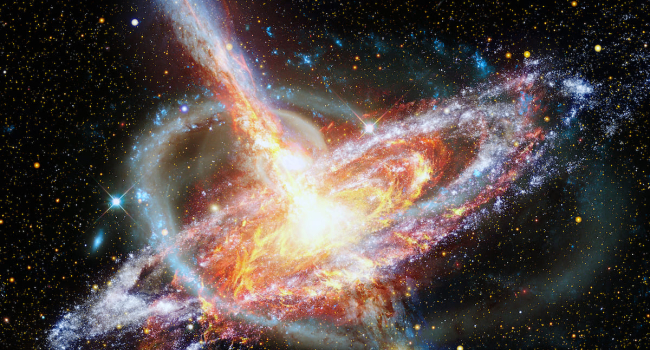
For more than 25 years, astronomers have debated one of the biggest mysteries in modern cosmology: why different methods produce different values for the rate at which the Universe is expanding — the Hubble constant. This discrepancy is known as the “Hubble tension.”
Now, a team of scientists from the University of Illinois Urbana-Champaign and the University of Chicago has proposed a new way to measure this value — using tiny ripples in space-time known as gravitational waves. Their method, called “stochastic sirens,” could serve as an independent referee in the debate. The study was published in Physical Review Letters on March 11, 2026.
Why the Hubble Tension Exists
The expansion rate of the Universe is measured in two main ways:
- “From below” — using nearby objects such as Type Ia supernovae and Cepheid variable stars. This yields one value.
- “From above” — using observations of the early Universe, particularly the cosmic microwave background within the standard cosmological model. This yields a different value — differing by several percent.
The difference may seem small, but in cosmology it is significant. It suggests that something may be missing in our understanding — either in the physics of the early Universe or in the physics governing the modern Universe. A third, independent method is needed — and gravitational waves may provide it.
How “Stochastic Sirens” Work
Gravitational waves are distortions of space-time produced when massive objects — such as black holes or neutron stars — merge. Observatories such as LIGO, Virgo, and KAGRA have already detected dozens of these events.
Instead of focusing on individual loud mergers, the team proposes studying the background hum — a faint, persistent signal created by thousands of distant, unresolved events. This gravitational-wave background contains information about the density of such mergers throughout space.
“We show that by using the background hum of gravitational waves from black hole mergers in distant galaxies, we can learn about the age and composition of the Universe,” said Daniel Holz of the University of Chicago.
The logic is straightforward:
- If the Hubble constant is smaller (the Universe expands more slowly), the available volume for mergers is smaller → the density of events is higher → the background is louder.
- If the Hubble constant is larger, the background is quieter.
By comparing the predicted gravitational-wave background with observations, researchers can calculate the Hubble constant independently of other methods.
Early Results and Future Prospects
Current LIGO–Virgo–KAGRA sensitivity is not yet sufficient to clearly detect this background. However, the team applied the method to existing data as a proof of concept and found hints of a higher Hubble constant — implying faster expansion. For now, this remains preliminary.
The real power of the method will emerge in five to six years, when detector sensitivity improves enough for the background signal to become distinguishable. At that point, “stochastic sirens” could provide a precise, independent measurement of the Hubble constant and potentially resolve the tension.
“This paves the way for applying the method in the future, as we continue to improve sensitivity, better constrain the gravitational-wave background, and possibly even detect it,” said co-author Caleb Cousins.
In Brief
Scientists propose measuring the expansion rate of the Universe using the background noise of gravitational waves from thousands of distant black hole mergers — so-called “stochastic sirens.” The method is independent of existing approaches and could resolve the Hubble tension — the discrepancy between measurements based on the nearby and early Universe. Initial tests hint at faster expansion, but true precision will come in 5–6 years as detectors improve. This may become the third — and decisive — way to measure how fast the Universe is growing.