make preferable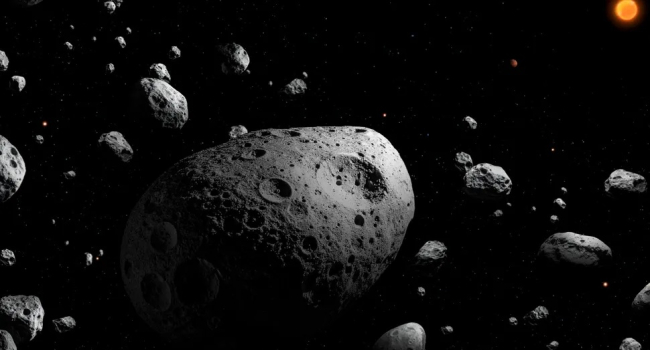
The Vera C. Rubin Observatory in Chile, which began operations last year, is already delivering impressive results. In the telescope’s first data set, scientists identified a record holder among asteroids: object 2025 MN45, which rotates faster than any known body of its size.
A record-breaking rotation speed
Asteroid 2025 MN45, with a diameter of about 710 meters (0.4 miles), completes a full rotation in just 1.88 minutes. According to the NSF National Optical-Infrared Astronomy Research Laboratory (NOIRLab), a partner in the project, this makes it the fastest-rotating asteroid larger than 500 meters ever discovered by astronomers.
The object is located in the main asteroid belt between Mars and Jupiter. Researchers note that eighteen of the nineteen other ultra-fast rotators with periods shorter than 2.2 hours found in the observatory’s first data also belong to the main belt.
Such rapid rotation provides important insights into the asteroid’s physical properties. Lead author Sarah Greenstreet, an astronomer at NOIRLab, explained that spinning at this speed requires exceptionally strong material. She noted that the asteroid must possess very high cohesive strength to remain intact and that calculations show it would need strength comparable to solid rock. This is unexpected, since most asteroids are believed to be rubble piles, consisting of loosely bound fragments held together mainly by gravity.
Researchers add that the absolute speed record is still held by much smaller asteroids, only a few meters across, which are capable of rotating in less than a minute.
Early discoveries from Rubin
The observatory began operations in spring 2025, and its first light images released in June immediately impressed the astronomical community. The initial data set already includes nearly 2,000 newly discovered asteroids, among them 19 ultra-fast rotators.
The telescope is equipped with the world’s largest digital camera, the 3.2-gigapixel LSST camera. Although its primary mission, the ten-year Legacy Survey of Space and Time, has not yet officially begun, scientists say the observatory is already demonstrating its enormous potential.
Aaron Roodman, deputy director of the LSST project and a professor at SLAC, said that astronomers had long expected Rubin to become a major discovery engine for the universe. He emphasized that the combination of the LSST camera and the observatory’s exceptional imaging speed allows it to take a picture every 40 seconds. He added that the ability to discover thousands of new asteroids in a short time and study them in detail offers a glimpse of what the full ten-year survey will reveal.
The results were published on January 7, 2026, in The Astrophysical Journal Letters and were also presented at the 247th meeting of the American Astronomical Society in Phoenix.
In brief
The Vera Rubin Observatory has discovered asteroid 2025 MN45, the fastest-rotating object larger than 500 meters, with a rotation period of just 1.88 minutes. Scientists conclude that its extreme spin implies a strength comparable to solid rock, challenging the common rubble pile model of asteroids. Among nearly 2,000 new asteroids found so far are 19 ultra-fast rotators. Researchers stress that this is only the beginning, as the observatory is preparing for a ten-year sky survey expected to deliver thousands of new discoveries.