make preferable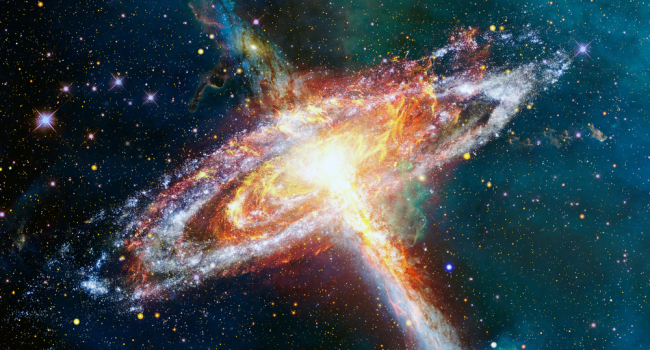
Physicist Naman Kumar from the Indian Institute of Technology Gandhinagar has crafted a novel theory suggesting the universe didn’t erupt from an infinitely dense point in a Big Bang. Instead, he posits that our universe and its mirror twin emerged simultaneously through a smooth quantum process. The study appears in Europhysics Letters (EPL).
A Fresh Take on Cosmic Birth
Traditional models like Hartle-Hawking’s or Vilenkin’s tunneling mechanism struggle to explain quirks of the early cosmos—its flatness or the dynamics of inflationary expansion. Kumar’s approach sidesteps these issues by leveraging a quantum potential rather than spatial curvature.
In his hypothesis, time in the universe’s infancy might have acted as an additional spatial dimension, forming what’s called a Euclidean instanton. Here, the universe starts with a finite size and transitions into its familiar state (the Lorentzian phase) via quantum mechanics—not a sudden bang.
Why It Matters
The classic Big Bang model envisions an initial singularity with infinite density and temperature, where physics as we know it breaks down—beyond even Einstein’s General Relativity. Kumar’s framework avoids such infinities, depicting a gradual cosmic evolution instead.
It also hints at an “anti-universe” where time flows backward. This could yield testable predictions, like patterns in the cosmic microwave background or the universe’s large-scale structure, offering a way to probe this radical idea.
What’s Next?
While intriguing, the hypothesis needs rigorous testing. Kumar aims to devise ways to hunt for observable clues that could validate or debunk his model. Should it hold up, it could upend our grasp of the cosmos’ fundamental laws.
This theory challenges the explosive origin story we’ve long accepted, proposing a quieter, quantum-driven dawn for the universe—and its mysterious twin.