make preferable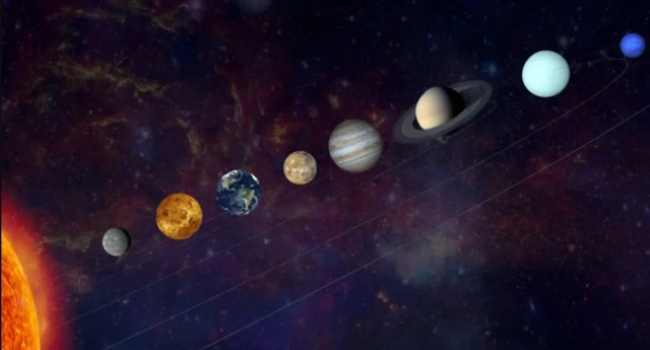
On Friday, February 28, several planets will align on one side of the Sun, forming what is known as an invisible minor planetary parade. However, observing it will be challenging, as most of the planets will be too close to the Sun. This was announced by Lyudmila Koshman, an astronomer at the Moscow Planetarium, in an interview with RIA Novosti.
Which Planets Are Involved?
Within a narrow sector of 20–30 degrees, Saturn, Mercury, Neptune, and Venus will cluster together. According to Koshman, only Venus will be visible to the naked eye from this group, though Mercury might also be spotted under favorable weather conditions.
In addition to these four planets, the rest of the Solar System’s objects will also be positioned on one side of the Sun, though spread across a wider sector of about 130 degrees.
Moreover, data from the Institute of Applied Astronomy of the Russian Academy of Sciences indicates that on the evening of February 28, seven planets will align: Saturn, Mercury, Venus, Jupiter, Mars, Uranus, and Neptune.
- The first five planets will be visible to the naked eye.
- Uranus and Neptune will require binoculars or a telescope.
Astronomer Nikolai Zheleznov explained that the phenomenon will be observable from west to east.
The next grand alignment, where seven planets will again line up on one side of the Sun, is not expected until May 19, 2161.
What Is a Planetary Parade?
The term “planetary parade” is used to popularize astronomy but is not strictly scientific. In a precise sense, planets very rarely align perfectly in a straight line—such events occur once in millions of years. More commonly, several celestial bodies appear relatively close to each other within a small angular sector, which is what’s referred to as a parade.
There are two types of parades:
- Major Planetary Parade: Involves five or more planets.
- Minor Planetary Parade: Occurs when four planets gather.
When the planets are too close to the Sun and invisible from Earth, the parade is dubbed “invisible.”